Revised Trauma Score
The Revised Trauma Score (RTS) is a scoring method used to quickly assess the severity of trauma in patients. It combines the Glasgow Coma Scale (GCS), systolic blood pressure (SBP), and respiratory rate (RR) to provide an objective measure of injury severity. RTS Score helps guide prehospital triage, emergency care, and prognosis prediction in trauma cases
RTS Score Calculator is intended for informational and educational purposes only. It should not be used as a substitute for professional medical advice, diagnosis, or treatment. Always consult your healthcare provider.
What is the Revised Trauma Score (RTS) ?
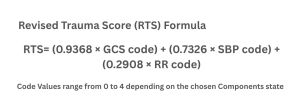
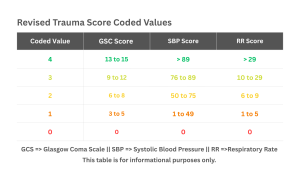
Revised Trauma Score (RTS) is quick physiological scoring method used to evaluate the severity of trauma and estimate the patients outcomes, and is used in prehospital and emergency situations. IT calculates a final score by combining the score form 3 factors that are respiratory rate (RR), systolic blood pressure (SBP), and Glasgow Coma Scale (GCS), and to each of this components is assigned a coded values (0-4) and weighted to give the final result.
The RTS score is useful for quick evaluation, determining the state of injury, and estimating mortality without the need for advanced testing because it simply depends on basic clinical observations. Trauma score is commonly used to improve evaluation and help with decision-making in clinical guidelines and trauma research.
Purpose of Revised Trauma Score (RTS score)
The main purpose of the trauma score is to offer a quick and reliable way to evaluate the severity of trauma and direct prehospital triage. Its especially helpful in emergency and prehospital situations when immediate action is essential since it helps in estimating patient prognosis based on basic physiological factors. Also, enables improved medical resource allocation and constant communication by improving trauma evaluation.
Components of the RTS Score
- Glasgow Coma Scale (GCS): Measures neurological status and consciousness.
- Systolic Blood Pressure (SBP): Indicates circulatory stability.
- Respiratory Rate (RR): Reflects respiratory function and shock.
Clinical Applications of Revised Trauma Score (RTS)
In clinical practice, the Revised Trauma Score (RTS) is used to quickly evaluate the severity of injuries and direct trauma care. It helps Emergency Medical Services (EMS) to determine if a transfer is required to higher level trauma hospital and assists patients triage and prioritize patients especially for those with multiple casualty situations. By including GCS, SBP, and RR, the RTS also predicts mortality, evaluates survival rates, and offers an objective evaluation for the total severity of injuries. Severe trauma can be can be determined by a lot RTS score, which indicated for immediate medical treatment to improve results. It has become popular as a standardized trauma treatment tool in prehospital and emergency department settings.
Advantages of RTS Score
Revised Trauma Score (RTS) has a number of important benefits, including being rapid and simple to use and it only requires simple physiological information (GCS, SBP, and RR). As a result, it is very useful in pre-hospital and emergency room settings. Its solid validation and proved mortality prediction power make it a dependable tool for triage and prognosis. RTS score with its simplicity gives a guarantied usability in low-resource situations. Research shows and supports the good accuracy, better specificity, and excellent interrater reliability when compared to certain other trauma evaluation methods.
Limitations of Revised Trauma Score (RTS)
There are some limitations related to RTS score, beside being a useful method. Its accuracy can be affected by prehospital treatments, and it is less useful for isolated head injuries and penetrating trauma. It does a good evaluation in predicting mortality, but there isn’t much data that support its capacity to predict functional outcomes or quality of life. RTS Score can be less reliable if some of the data is placed incorrectly or are missing.
Also, in some cases it may underestimate the severity of head injuries. The weighted RTS version still needs evaluation for the effectiveness, and more research needs to be done to see how useful it is. These limitations said show that more and better trauma scoring methods need to be developed.
FAQS for
Is the RTS still used today?
Yes, the RTS is still used, but it depends on the situation. Emergency medical teams often use the simple Field RTS to make quick decisions. The more detailed RTS is used in research and in other scoring systems like TRISS. Newer scoring systems are also available that may be more accurate.
How is RTS different from TRISS?
RTS looks only at vital signs and the patient’s physical condition. TRISS goes further—it combines RTS with an anatomical score (ISS) and also considers the patient’s age and how the injury happened. This makes TRISS better at predicting survival than RTS alone.
Can RTS be used for patients under the influence of drugs or alcohol?
It can be tricky. Drugs or alcohol can change a patient’s consciousness, which affects the RTS because it relies heavily on the GCS. In these cases, doctors need to use their judgment, and the RTS should only be one part of the assessment.
Why might RTS lead to undertriage?
Sometimes, RTS can miss serious injuries early on. This is because it mainly looks at vital signs, which may still be normal even if a patient has a serious internal injury. A patient might seem stable at first, leading to a delay in getting to a trauma center.
What does the RTS score show?
The RTS gives a number that shows the patient’s chance of survival. A higher score means the patient is more likely to survive, while a lower score suggests more severe injuries and a higher risk of death.
More Tools to Support Your Health
Our website is dedicated to providing tools that empower you to make informed health choices and take control of your body and mind. We offer a variety of health-related calculators, including the Trauma Score Calculator, to support your overall well-being.
Explore the tools below and many more, just a search away. If you don’t find a specific test or calculator, feel free to contact us, and we’ll be happy to create it for everyone.
Glasgow Coma Scale (GCS)
A quick way to assess a patient’s level of consciousness after a brain injury.
Padua Prediction Score for Risk of VTE
A tool to estimate a hospitalized patient’s risk of developing blood clots (VTE).