
Ranson’s Criteria for Pancreatitis Mortality
Ranson’s Criteria is a widely used clinical scoring system that helps predict the severity and mortality risk of acute pancreatitis. This page provides a clear overview of the criteria along with a practical calculator to quickly assess patient risk.
Ransons Criteria calculator is intended for informational and educational purposes only. It should not be used as a substitute for professional medical advice, diagnosis, or treatment. Always consult your healthcare provider.
Overview of Acute Pancreatitis
Acute pancreatitis is an unexpected inflammation of the pancreas, which is mainly caused by gallstones or heavy consuming of alcohol. Early detection and monitoring are eesential because serious conditions can result in serious life-threatening ones that may include organ failure and localized pancreatic damage, even though many cases are minor and go away in a few days. When patients in high risk are detected on early stage makes possible to minimize negative outcomes. Clinical decision-making and severity prediction can be assisted by scoring systems such as Ranson’s Criteria.
Importance of Early Risk Stratification
In acute pancreatitis, early risk stratification is essential for identifying patients who are at high risk of developing severe illness, directing fast medical treatment, and improving the results. By determining severe cases early, it lowers mortality, improves intensive treatment for those in need, and assists in the efficient allocation of healthcare resources. Healthcare providers use clinical method and scoring system such Ranson Criteria and APACHE II, alongside with biomarkers such serum calcium, CRP, procalcitonin, and neutrophil-to-lymphocyte ratio to determine severity. Imaging tests such as ultrasound, CT, and MRI help find the cause of pancreatitis and check for any complications.
What is Ranson’s Criteria for Pancreatitis Mortality
One method for predicting the severity of acute pancreatitis and identifying people who are more likely to have complications or pass away is Ranson’s Criteria. It is based on 11 clinical factors and laboratory test that are evaluated upon admission and during the first 48 hours of hospitalization. Healthcare providers can have a better medical treatment plan, monitoring patients more closely, and determining if intensive care or specialized interventions are required by examining the changes in these factors.
Components of Ranson’s Criteria
The components of Ranson’s Criteria are divided into two phases. The first phase has five clinical and lab factors assessed at admission, and the second phase six additional factors evaluated after 48 hours. This 2 phases help to estimate the severity and potential mortality risk of acute pancreatitis.
1. On Admission parameters:
- Age > 55 years
- White blood cell count > 16,000/mm³
- Blood glucose > 200 mg/dL
- Serum AST > 250 U/L
- Serum LDH > 350 U/L
2. 48-hour parameters:
- Hematocrit fall > 10%
- BUN increase > 5 mg/dL
- Serum calcium < 8 mg/dL
- Arterial PO₂ < 60 mmHg • Base deficit > 4 mEq/L
- Fluid sequestration > 6 L
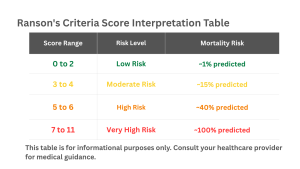
Clinical Applications of Ranson’s Criteria
Doctors use the Ransons criteria to determine people at risk for severe acute pancreatitis and its potential consequences. It helps with decision-making for surgical operations, informs fluid resuscitation and other supportive treatments, and directs triage to critical care units. Also, the score give an estimation for mortality risk to help with early management and monitoring plans. Doctors also have the opportunity to prioritize actions and resources for patients who are most likely to benefit from critical care.
Advantages of Ranson’s Criteria
Ranson criteria is a well structured and easy method that assists in determining the serious outcomes in cases of acute pancreatitis. This pancreatic criteria provides a precise severity level, enables early risk classification, and directs medical treatment choices. For a more detailed estimation ransons criteria pancreatic can be combined with imaging results for better evaluation procees. Due to its simplicity in usage, it can be used even in situations with low recourses. t continues to be a useful guide in clinical practice even with more recent scoring methods.
Limitations of Ranson’s Criteria
Ranson criteris beside being a useful toll it comes with some limitations. Some of the limitations include the 48-hours evaluation delay, less accurate compared to more recent scoring methods, and the lack imaging info to identify local problems. Also, it depends on lab results that cant be always available ,sometimes might be difficult to implement in practice, and it is not well evaluated to be used in children. From the limitation ransons criteria can be less pratical to be used in quick or routine check in clinical settings. It still has historical significance, and in some situations, it can offer baseline direction.
More Tools to Support Your Health
Our website is dedicated to providing tools that empower you to make informed health choices and take control of your body and mind. We offer a variety of health-related calculators, including the Ransons Criteria Calculator, to support your overall well-being.
Explore the tools below and many more, just a search away. If you don’t find a specific test or calculator, feel free to contact us, and we’ll be happy to create it for everyone.
Fibrosis-4 (FIB-4) Index
A simple score to estimate liver fibrosis using routine blood tests and patient age.
Alvarado Score Calculator
A quick tool to assess the likelihood of acute appendicitis based on clinical signs and symptoms.x