
PSI/PORT Score – Pneumonia Severity Index of CAP
The PSI/PORT Score (Pneumonia Severity Index) is a clinical tool used to assess the severity and mortality risk of community-acquired pneumonia (CAP). It considers factors such as age, comorbidities, and vital signs to classify patients into risk categories. This scoring system helps clinicians decide on appropriate treatment settings and interventions.
PSI/PORT Score calculator (Pneumonia Severity Index of CAP) is intended for informational and educational purposes only. It should not be used as a substitute for professional medical advice, diagnosis, or treatment. Always consult your healthcare provider.
What is of Community-Acquired Pneumonia (CAP)?
Community-Acquired Pneumonia (CAP) is a lung illness that is caused by bacteria, viruses or fungi that that are received outside of hospitals. Fever, coughing, sputum production, breathing difficulty, chest discomfort, feeling tired, and confusion in elderly adults. To have a proper medical evaluation, diagnosing relies on lab testing, a physical examination and a chest X-ray.
Depending on the severity and the type of illness the treatment may be different like antibiotics for bacterial infection, medical care for viral infections and for severe cases hospitalization is needed. Some risk factors are smoking, long-term lung illness, long-term medical issues, high alcohol use and elderly age. To prevent this types of illness vaccination, good hygiene, and healthy lifestyle habits are the key thing to do.
Challenges in CAP Management
Community-Acquired Pneumonia (CAP) comes along with some challenges in managing part that may include difficulty in accurately diagnosing severity, the type of bacteria and choosing the best medical treatment. The usage of empirical antibiotic can lead to resistance and choosing the appropriate antibiotic type is also difficult. Additional issues involve deciding the care setting, differentiating between bacterial and viral pneumonia are other concerns. Managing pneumonia is made more difficult by different access to healthcare, patients self-treating, shifting pathogens, and an inability to recognize increasing illnesses.
Risk Stratification in Community-Acquired Pneumonia (CAP)
Risk stratification assists in determining which patients require hospitalization and which may be safely handled as outpatients. It helps in directing treatment choices, avoiding unnecessary hospital stays, high-risk patients receive careful monitoring and intensive care, and it helps in the effective use of healthcare resources.
CURB-65 score and the Pneumonia Severity Index (PSI) are common methods used to evaluate the probability of risk levels related to complications and mortality risk rate. To maximize patient treatment, clinical judgment and other elements like oxygen levels, comorbidities, and biomarkers should be taken into account even if these instruments offer objective advice.
Introduction to PSI/PORT Score
A clinical method for evaluating the risk of complications and death in adult patients with community-acquired pneumonia (CAP) is the Pneumonia Severity Index (PSI score), also known as the PORT score. The patients in this method are classified into 5 risk level classes that are based on factors such as comorbidities, physical examination, and laboratory data. This can help in directing choices about hospitalization, the intensity of therapy, and getting out. PSI score is a very accurate tool, despite the great accuracy, the score is complicated and takes several data, this makes doctors s that sometimes to use more simplier methods like CURB-65 in emergency cases. Doctors medical judgment is still very crucial in managing patients with PSI score.
Importance of the PSI/PORT Score
PSI/PORT Score give a strandard method for estimating the risk level of mortality and complications in patients with CAP. It helps medical providers to make well informed decisions on hospitalization, having a clear lead for the intensity of treatment and allocating medical recourses. Patient that may be in high risk levels mat need hospital care, on the other hand, low risk patients often can be treated at home. The score supports evidence-based clinical management and provides that patients receive effective treatment by taking into factors including age, comorbidities, and vital signs.
How PSI/PORT Score Works
PSI/PORT Score main task is to identify and classify the patients with community-acquired pneumonia (CAP) into the 5 risk categories. The points are assigned based on different factors such as demographic data like age and sex, complication from conditions that are related to heart, liver, kidney, or cancer. Also, some other factors are included like examination results from vital sing and mental state, laboratory test or radiology results like blood tests and chest X-ray imaging.
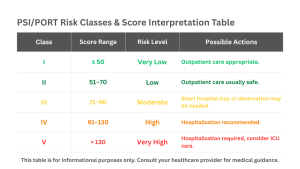
Healthcare providers use the PSI score to make well-informed decisions about hospitalization, outpatient treatment, and getting the healthcare recourses. Also, healthcare professional use the score to classify and evaluate patients risk class, that range from Class I that considered low risk and Class V high risk, below you will have the interpretation of each score range and their related class of PSI/Port Score.
Clinical Application of PSI/PORT Score
As we have talked so far PSI score is mainly used for choices related to hospitalization for patients with CAP. It assists in identifying low-risk patients who may be treated at home and those who are at higher risk and need hospital treatment that are classified by their risk class. Compared to less advanced methods, this score offers a more accurate evaluation of the severity and outcome of the condition. Doctors are helped by this score by making reliable decisions for medical treatment choices. Also, the recourses gathered are more accurate and for patients at high risk receive the right treatment and monitoring.
Advantages of PSI/PORT Score
For patients suffering from community-acquired pneumonia, the PSI/PORT score offers a very reliable way to predict mortality and poor outcomes. It identifies patients who could require more advanced treatment, such as ICU admission. PORT Sore assists doctors in making well-informed decisions regarding hospitalization, and combines a number of factors, such as illnesses and medical results, for an in-depth risk evaluation. It promotes improvement in quality as a standardized method by enabling trend analysis and outcome tracking. Being a detailed and comprehensive tool, it provides more accuracy in determining patient risk, especially for patients who are immunocompromised or at high risk.
Limitations of PSI/PORT Score
Beside having a good application and advantages the PSI/PORT score some along with some limitations. As a complex method that includes 20 factors, makes it challenging to use it regularly in busy hospitals. It can underestimate the intensity of risk in elderly patients with diseases and also younger, healthy patients. Not every important factor are taken into account, such as recent hospitalizations, social issues, and specific chronic illnesses. Also , in predicting the need of intensive care unit (ICU) it is less reliable. Overall, it should never be used as a substitute for clinical judgment when making decisions but should be used alongside with clinical judgment.
Discover More of What We Offer
Our website is focused on providing tools that inspire people to make healthier choices and take charge of their body and mind. We feature a range of health calculators, such as the PORT / PSI Calculator, all designed to support your overall wellness.
Below, you’ll find two examples of these tools, with many more available through a quick search. If you don’t see the test or calculator you’re looking for, simply reach out. We will be happy to create it for you and others who may benefit.
ARISCAT Score Calculator
A tool to estimate the risk of postoperative pulmonary complications in surgical patients.
CURB-65 Score Calculator
A quick score to assess pneumonia severity and guide treatment decisions.