
Prostate Tumor Volume & Density
Prostate Tumor Volume & Density are important measurements used to assess the size and aggressiveness of prostate cancer. These metrics help doctors estimate risk, guide treatment decisions, and predict potential outcomes. This page also includes a calculator to help estimate tumor volume and PSA density, providing a clearer understanding of risk and aiding treatment decisions.
PSA Density Calculator is intended for informational and educational purposes only. It should not be used as a substitute for professional medical advice, diagnosis, or treatment. Always consult your healthcare provider.
Prostate Cancer Overview
When cancerous cells start to develop and grow out of control in the prostate, they can create a tumor that may advance to other body areas, and this is how prostate cancer begins. It usually grows slowly and may not show any symptoms at first, but in later stages, bone pain or urinary problems may appear. Older age, family history, and certain ethnic or cultural origins are risk factors. PSA tests, biopsies and imaging are common ways that are used to evaluate, active regular monitoring, surgery, radiation, and hormone therapy are among the available treatment choices. Patient outcomes and treatment performance are improved by early detection.
Importance of Accurate Diagnosis for Prostate Cancer
Proper and accurate diagnosing of the prostate cancer is crucial for early, efficient treatment , that increases the survival chances and maintains quality of life by reducing side effects. It lowers patient anxiety, prevents needless operations, and offers personalized treatment strategies. What is used and the efficient way in diagnosing the illness relies on digital rectal examination, modern imaging (MRI), PSA testing, and collaborative decision-making between patients and medical professional. Accurate diagnosis also helps identify aggressive cancers early, ensuring immediate treatment before the illness worsens or spreads
Current Challenges in Prostate Cancer Assessment
Some of the difficulties in evaluating the prostate cancer include the poor specificity of PSA testing, which can result in over diagnosing and unneeded biopsies. It can be difficult to tell the difference between aggressive and slow-growing tumors, which might lead to overtreatment in certain cases. While they increase the aaccuracy, advanced diagnostic techniques like multiparametric MRI and PSMA PET scans are expensive and not commonly available.
Prostate cancer testing access and treatment are not the same in all the places, and hospital ccare might vary in quality compared to each other. Doctors are trying to improve this by developing better blood and urine tests, employing MRI to more precisely guide biopsies, and gathering information to speed up diagnosis and prevent needless treatments.
Tumor Volume & Density: Why They Matter
Tumor volume gives a precise 3D analysis of the tumor size, that provides a stronger predictive value than basic diameter measures. Also, it helps in guiding the medical treatment decisions in surgery, radiotherapy, and clinical studies. By identifying the types and number of cells in the tumor and the degree of aggressiveness, tumor density works together with volume and affects the response to treatment. Volume and density support each other to provide an accurate understanding of tumor development, effectiveness of treatment, and personalized medical treatment plans, which helps with research accuracy and clinical decision-making.
What is Prostate Tumor Volume?
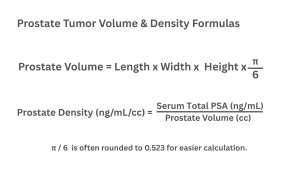
Prostate Tumor Volume is known as the entire size of prostate cancer, and is measured in cubic centimeters or as a proportion of the gland size. It helps in determining the level of cancers aggression, directs medical treatment, and estimates the probability of recurrence. Tumor volume is measured by examining the removed prostate after surgery, analyzing biopsy samples, or using 3D imaging. Bigger tumors generally mean more serious cancer, and watching changes in volume helps see if treatment is working.
What is Prostate Tumor Density?
Prostate Tumor density is concept that is connected to in accessing the risk of cancer and is sometimes used along side with Prostate-Specific Antigen Density (PSAD), a measure that shows the amount of PSA in the prostate gland. In order to differentiate prostate cancer from benign illnesses and inform decisions on biopsies or treatment, a higher PSAD indicates a greater risk of prostate cancer. A better prognosis and decreased risk are often indicated by lower PSAD readings. It is a helpful tool for determining the aggressiveness of tumors and evaluating the possibility of recurrence. In order to determine if more aggressive treatments or active surveillance are required, it can often be combined with other clinical indicators or methods.
Clinical Significance of Tumor Volume & Tumor Density
Tumor volume which represents the whole amount of cancerous cells, is a powerful indicator of aggressiveness, metastasis risk, reaction to medical treatment, and recurrence. It can often provide more accurate prognostic data than tumor stage alone. Tumor density offers provides information on the internal nature of the tumor, by differentiating between aggressive and indolent tumors and predicting the efficacy of treatment. Density and volume work together to improve risk evaluation, direct treatment choices (such as radiation, surgery, or active monitoring), and provide more individualized patient care.
Tumor Volume & Density in Risk Stratification
Tumor density indicates the amount of dense or metabolically active tissue within a tumor, but tumor volume determines the tumor’s total size. Both are essential predictive indicators, bigger tumor volumes typically signal a worse outcome, while higher tumors densities may point to more aggressive illness. These factors may be carefully measured using imaging techniques like MRI and PET/CT. Metrics gathered through PET/CT, such as metabolic tumor volume (MTV) and total lesion glycolysis (TLG), are especially good indicators of the rate at which a cancer will develop, respond to treatment, and survive. When combined, tumor density and volume optimize risk estimation and provide more individualized treatment planning for a variety of cancer types.
Advantages of Prostate Tumor Volume and Density
Tumor volume, which represents the cancer’s actual size, and is related to tumor biology, progression, recurrence risk, and treatment choices. While only small amounts (<0.5 cm³) can be suitable for active surveillance, larger volumes are predictive of more aggressive illness and undesirable characteristics such extracapsular expansion or metastasis.
By adjusting tumor burden for total prostate size, tumor density, often referred as PSA density, provides a more accurate risk assessment. When used with MRI, it can decrease unnecessary biopsies, guide biopsy decisions, indicate aggressive illness in some situations, and go above PSA or Gleason score alone.
Limitations of Prostate Tumor Volume & Density
Measuring tumor volume and density can provide useful measurements, but both of them have some limitations. The evaluation of the tumor volume is faced by challenges such irregular tumor development, poor imaging, and a weak relation between biopsy and final pathology. Especially in low-grade tumors when volume is not strongly connected with outcomes, its predictive utility may be limited.
Accurate prostate volume evaluation is crucial for tumor density, , which differs among imaging techniques and operators. Its application is made harder by the lack of specified standard rules for using tumor density, and the cut-off values often overlap, which means some men may get unnecessary biopsies while others with serious cancer might be missed. Accuracy can also be impacted by body weight, prostate size, and differences between populations can also affect the results, making tumor density less reliable on its own.
FAQs on Prostate Volume & PSA Density
What is prostate volume?
Prostate volume is the size of the prostate gland, measured with scans like ultrasound or MRI. The average adult prostate is about 20–25 cc (cubic centimeters).
What is PSA density (PSAD)?
PSA density is the PSA level in your blood divided by the size of your prostate. It helps give a clearer picture than PSA alone.
Why is PSA density important?
PSA levels can rise for many reasons, like prostate size or inflammation. PSAD adjusts for this, making it more reliable for checking cancer risk.
What is considered a low or high PSAD?
A PSAD under 0.15 is usually seen as low risk, while a PSAD of 0.15 or higher suggests a higher chance of significant cancer.
How is prostate volume measured?
Doctors measure prostate length, width, and height during scans (MRI or ultrasound) to calculate its size.
How do doctors use PSA density in decisions?
If your PSAD is low, you might be safely monitored with active surveillance. If it’s higher, doctors may recommend further tests like a biopsy.
Explore More Helpful Health Tools
Our website is here to create tools that help people to make better life choices and having your body and mind in control. We provide a range of health related tools like the Prostate Size Calculator designed to support your well-being.
Below you will find a couple of them and much more that are just a search away . If you don’t find any specific test or calculator you’re looking for please feel free to contact-us so we can create it for everyone.
Creatinine Clearance Calculator
Quickly estimates kidney function using the Cockcroft-Gault equation.
Calcium Correction Calculator
Adjusts calcium levels accurately for low or high albumin levels.