
PEWS Score – Pediatric Early Warning Score
The Pediatric Early Warning Score (PEWS) is a clinical tool used to detect early signs of deterioration in hospitalized children. This article explains how PEWS works, its benefits, limitations, and includes a practical calculator to help healthcare providers assess a child’s risk quickly and accurately.
PEWS Score calculator is intended for informational and educational purposes only. It should not be used as a substitute for professional medical advice, diagnosis, or treatment. Always consult your healthcare provider.
What is Clinical Deterioration in Children?
In children, clinical deterioration is defined as a dynamic decline in health that includes abnormalities in behavior, mental state, or vital signs that, if not identified early, might result in major consequences. Regular monitoring with the help of tools like Pediatric Early Warning Score (PEW Score) is essential early diagnosis and treatment since warning symptoms of illnesses may be minor and symptoms may differenciate by age. In terms of preventing problems like cardiac arrest, early detection increases overall results and survival.
Why Early Warning Systems are Needed in Pediatrics
In pediatrics, early warning methods such as PEWS score method are essential for identifying minor but important indicators deterioration, offering a uniform method for evaluating childrens health and assuring the right treatment. They had their impact in lowering the mortality rate and increasing healthcare providers confidence in taking care for critically sick child’s. They also help in improving the collaboration between the healthcare teams and minimize variability among hospitals. This methods reduce the confusion in decision-making and makes sure that no early indicators are missed by providing precise score and response actions. This eventually leads to more consistent results in various healthcare settings and safer pediatric treatment.
Challenges in Pediatric Monitoring
The lack of pediatric-specific equipment, trouble getting children to collaborate, the additional complexity of involvement by parents, and ethical problems are some of the particular difficulties associated with kid monitoring. Monitoring is made more difficult by technological concerns such as device design, sensor sensitivity, and connectivity limitations. Also, immediate treatment suffers by diagnosis delays, a lack of research data, and inconsistent disease presentations. Effective pediatric monitoring is also greatly restricted by a lack of resources, insufficient staffing, and training problems, particularly in low-resource settings.
What is Pediatric Early Warning System?
PEWS (Pediatric Early Warning System) is method/tool used in hospitals to identify the early indicators of childs deterioration. Vital indicators (that will be listed below) are monitored, and a score is calculated to get the results, and then the result is evaluated under professional judgment with the help of parental concerns. The score ensures early detection and regular response that improves outcomes by guiding immediate actions, such as clinical evaluation, closer monitoring, or escalation to higher-level treatment. By providing more rapid actions, the score assists in the prevention of medical emergencies. Also, it improves family and healthcare team communication.
Components of PEWS
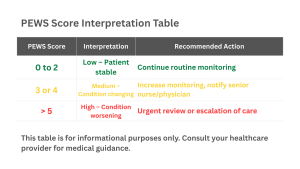
To each of the components is added a score that ranges from 0 to 3 points. For each sum of the scoring range will be an evaluation table for the PEWS score below.
- Behavior (e.g., alert, irritable, lethargic).
- Cardiovascular (heart rate, capillary refill, color).
- Respiratory (respiratory rate, effort, oxygen requirement).
- Optional additions depending on institution (e.g., temperature, urine output, quarter-hourly nebulizers, persistent vomiting post-surgery).
Clinical Use of PEWS
The Pediatric Early Warning System (PEWS) provides a method for tracking vital signs to identify early signs of deterioration in hospitalized children. It gives a brief overview of the child’s health by giving scores to factors including blood pressure, oxygen saturation, heart rate, respiration rate and consciousness level. High score is the reason to activate a clear plan for responding such as intensive care unit (ICU) transfer, or increased monitoring. This method promotes consistent decision-making in pediatric care, ensures timely treatments, and optimizes patient safety.
Limitations of PEWS
PEWS score Due to its limited sensitivity and specificity, makes it vulnerable to false alarms or missed detections. Complete and accurate data collection is necessary to have a correct evaluation, but this allows for human mistake to be done. Staff workloads, training requirements, and limited resources can all affect implementation of PEWS score. The method’s effectiveness varies depending on the circumstances, and it cannot reliably predict mortality risk. Immediate action is still crucial, and the method supports clinical judgment but cannot take its place.
Advantages of PEWS
Early deterioration diagnosing is made possible by PEW Score, which makes possible to have quick responses that increase outcomes including lower mortality, fewer intensive care unit transfers, and shorter hospital stays. It provides to nurses an objective tool for raising issues, improves staff communication, and offers an organized monitoring system. It also lowers healthcare costs, improves patient and family engagement, and supports priority choices. Beyond providing urgent care its usage can assist in the strength of trust between families and healthcare providers over time.
Practical Example of Pediatric Early Warning System
Using a standardized PEWS chart, a healthcare provider regularly evaluates a child’s vital signs, oxygen requirements, and level of consciousness. To each of the evaluations done is give a score. If the score is determined as high one it requires an immediate attention from a senior doctor or specialist . On the other hand, if the score is evaluated to low, regular monitoring keeps going, and for moderate score it means a greater chance of deterioration and frequent checks.
FAQs about PEWS
How often should PEWS be checked?
Check and score PEWS every time you take the child’s vital signs. Children with higher or rising scores should be checked more often.
What does a high PEWS score mean?
A high score shows the child’s condition is getting worse and may need different treatments or medications.
How is PEWS different from normal ranges?
PEWS shows when to get senior help, not just whether a reading is “normal”.
What if a child’s vital signs are in the high-risk zone?
High-risk readings mean the child needs urgent review and care from senior staff.
Is clinical judgment still important?
Yes. PEW score is a guide to help, but it does not replace a clinician’s skill and experience.
Explore More Helpful Health Tools
Our website is here to create tools that help people to make better life choices and having your body and mind in control. We provide a range of health related tools like the PEWS Score Calculator designed to support your well-being.
Below you will find a couple of them and much more that are just a search away . If you don’t find any specific test or calculator you’re looking for please feel free to contact-us so we can create it for everyone.
Modified Early Warning Score (MEWS)
A clinical tool used to detect early signs of deterioration in adult patients by scoring vital signs and physiological changes.
PSI/PORT Score (Pneumonia Severity Index)
A scoring system that estimates the severity and mortality risk of community-acquired pneumonia to guide treatment decisions.