
PESI Score – Pulmonary Embolism Severity Index
The Pulmonary Embolism Severity Index (PESI) is a clinical tool used to estimate the 30-day risk of mortality in patients with acute pulmonary embolism (PE). By evaluating factors such as age, vital signs, and comorbidities, it helps clinicians classify patients into different risk categories. PESI supports decision-making for treatment intensity, hospitalization, and safe outpatient management.
PESI Score Calculator is intended for informational and educational purposes only. It should not be used as a substitute for professional medical advice, diagnosis, or treatment. Always consult your healthcare provider.
Introduction to Pulmonary Embolism (PE)
A pulmonary embolism (PE) is a dangerous medical condition in which a blood clot, often from a deep vein in the leg (DVT), blocks an artery in the lung. Some of the common symptoms may be chest discomfort, increased heart rate, coughing, fainting, and breathing difficulties. Some risk factors may be long-term immobility, surgery, cancer, hormonal treatments, pregnancy, obesity, and being older than 40. The process of diagnosing PE is done by Imaging techniques such as ventilation-perfusion scans or CT pulmonary angiography. Anticoagulants, thrombolytic treatments, catheter-directed therapy, surgical clot removal, and in some situations, an IVC filter to stop future clots are all offered as treatment options.
Importance of Early Detection
Early identification of PE is essential, because it is a life-threatening condition and high potential for early mortality. Quick detection enables immediate medical treatment, which lowers the risk of mortality, acute consequences including right ventricular failure, and long-term problems like chronic pulmonary hypertension or recurring embolisms. To have an accurate and precise early detection is reached by knowing the symptoms, clinical estimation using risk scores methods, diagnostic imaging like as CTPA, and blood tests like D-dimer. In this days the new technologies are included, like artificial intelligence (AI), which helps doctors make faster decisions and detect PE earlier.
Importance of Risk Stratification in PE
The importance of pulmonary embolism (PE) risk stratification is crucial for directing medical therapy, choosing the appropriate care environment, and identifying patients in need for emergency treatment. It helps healthcare providers in determining whether a patient may be safely treated with anticoagulation alone or needs more intensive medical treatment, such as reperfusion. Doctors may optimize the use of resources, improving overall patient outcomes, and customize treatments to individual risk levels by evaluating clinical variables, biomarkers, imaging results, and proven techniques like PE risk satisfaction or Hestia criteria.
What is the Pulmonary Embolism Severity Index (PESI)?
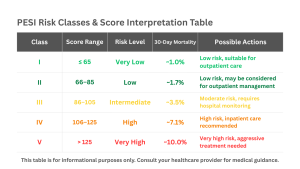
The Pulmonary Embolism Severity Index (PESI) is clinical method that calculates the he 30-day mortality risk in patients with acute PE. The PESI score is evaluated by 11 clinical criteria and to each of them is assigned a score and this criteria include age, comorbidities, vital signs, and oxygen saturation. Healthcare providers can use the total score in order to guide medical treatment, and evaluate if a patient needs to be hospitalized , and give short-term prognostic information.
PESI Score evaluates the patients into 5 risk classes ranging from low to very high risk. The ability to differentiate between patients who need close monitoring and those who may be successfully treated as outpatients is another benefit. In order to support patients receive the correct care at the right time, medics may make better treatment decisions and use healthcare resources more effectively by standardizing risk assessment using the method.
Components of PESI Score:
- Age – How old the patient is.
- Male sex – Points if the patient is male.
- Cancer – If the patient has or had cancer.
- Heart Failure – If the patient has heart failure.
- Chronic Lung Disease – If the patient has a long-term lung problem.
- High Pulse Rate – Heart rate 110 beats per minute or higher.
- Low Blood Pressure – Systolic blood pressure under 100 mmHg.
- High Breathing Rate – Breathing 30 times per minute or more.
- Low Body Temperature – Temperature below 36°C.
- Altered Mental Status – Confusion, disorientation, or unusual sleepiness.
- Low Oxygen – Blood oxygen level below 90%.
Clinical Applications of PESI
This method helps in calculating the mortality rate and major complications risk for pulmonary embolism patients. Helps doctors make the right care decisions, it estimates if the patient cane be treated as outpatient for low-risk cases and to intense treatments for high-risk patients. PESI Score helps in improving the efficient use of hospital resources and assists in decision-making with the help of other diagnostic methods like biomarkers and imaging. By giving precise predictive information, it provides improved treatment for patients.
Limitations of PESI Spore
The Pulmonary Embolism Severity Index until now you have an understanding of the main advantages of the it, but it comes along with some limitations. It may underestimate the risk in some cases, can be difficult to calculate, and may be less accurate for younger people. The method focuses on short-term mortality and ignores social components, and particular situations. Additional prospective study is required for better long-term risk prediction and increase accuracy, as many validations are retrospective.
FAQS for Pulmonary Embolism Severity Index (PESI)
How does PESI help clinicians?
It helps determine the appropriate treatment intensity, decide whether patients can be treated as outpatients, and identify those needing urgent interventions like reperfusion therapy.
Can PESI predict long-term complications?
No, PESI mainly predicts short-term (30-day) mortality. It does not provide information about long-term outcomes or bleeding risks.
How is the PESI score calculated?
The score is calculated based on 11 clinical factors, including age, sex, comorbidities, vital signs, oxygen saturation, and mental status. Points are summed to categorize patients into five risk classes.
Who should use the PESI score?
PESI is intended for healthcare professionals assessing adults diagnosed with acute pulmonary embolism to guide risk stratification and treatment planning.
Can PESI be used at home by patients?
No, PESI requires clinical measurements and evaluation by a medical professional, including vital signs, lab results, and comorbidities, so it is not suitable for self-assessment.
More Tools to Support Your Health
Our website is dedicated to providing tools that empower you to make informed health choices and take control of your body and mind. We offer a variety of health-related calculators, including the PESI Score Calculator, to support your overall well-being.
Explore the tools below and many more, just a search away. If you don’t find a specific test or calculator, feel free to contact us, and we’ll be happy to create it for everyone.
PSI/PORT Score
Estimates the severity and mortality risk of community-acquired pneumonia (CAP) to guide treatment decisions.
COPD Assessment Test (CAT)
Evaluates the impact of COPD symptoms on a patient’s daily life and well-being.