
Padua Prediction Score for Risk of VTE
The Padua Prediction Score is a validated clinical tool used to estimate the risk of venous thromboembolism (VTE) in hospitalized patients. It assigns points based on patient risk factors such as active cancer, reduced mobility, and previous VTE events. Higher scores indicate increased risk, helping clinicians decide on the need for preventive measures
The calculator is intended for informational and educational purposes only. It should not be used as a substitute for professional medical advice, diagnosis, or treatment. Always consult your healthcare provider.
Why Another Risk Score Was Needed
Venous thromboembolism (VTE) continuous to be one of the most common preventable causes of mortality and complications for hospitalized patients. In one of our previous tool and articles we introduced the Caprini Score (2005), a reliable method for determining surgical patients’ risk of VTE. If you want to know what is VTE, risk factors and why risk assessment is important you can visit the Caprini Score (2005) page. Not all the patients in hospital can be there only for surgical cases, they can be hospitalized for different illnesses such as cancer, heart failure, or infections. This patients are also in danger and high risk for developing VTE. Researchers have also created other tools like the PADUA Prediction Score that is a risk assessment tool for patients, designed especially for hospitalized this patients. This scoring method lowers the possibility of missing high-risk cases and assists doctors in determining which patients can benefit from preventative anticoagulant medication.
What is Padua Prediction Score?
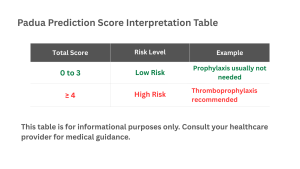
Padua prediction score is clinical method used and created to evaluate hospitalized patients that have a risk of venous thromboembolism (VTE). The risk factors that are part of the sccore to each of them is assigned a score based on the severity. Some of the risk factors are active cancer, previous VTE, old age, recent surgery or trauma, etc. IF the sum of the score is below 4 it indicates a low risk, while if the score is equal or greater than 4 it means a high risk indicating the need for preventative steps against VTE. The score is usually used by the healthcare providers together with clinical judgment to have guided choices on the prevention of pulmonary embolism (PE) and deep vein thrombosis (DVT).
Components (Risk Factors)
- Active cancer
- Previous VTE
- Reduced mobility ≥3 days
- Known thrombophilic condition
- Recent trauma or surgery (<1 month)
- Age ≥70 years
- Heart or respiratory failure
- Acute myocardial infarction or ischemic stroke
- Acute infection or rheumatologic disorder
- Obesity (BMI ≥30)
- Ongoing hormonal treatment
Clinical Use of the Score
Hospitalized patients with risk of VTE are categorized using the score, which helps in determining whether prophylactic measures are necessary. Patients with low-risk are usually typically receive treatment with normal monitoring, while high-risk patients indicated by the score are given priority for preventative actions to lower the chance of VTE. Padua score supports the doctors by helping in making evidence based decisions to avoid VTE. Before giving preventive treatment, doctors should check the patient’s risk of bleeding and decide the type, amount, and length of treatment based on the patient’s condition. In general, this method supports and focuses on preventive care, which results in better safety and outcome of the patients.
Advantages of Padua Score
Healthcare providers can provide focused preventative treatment by using the method to identify hospitalized patients who are at high risk for VTE. The score lowers the risk of bleeding and medical costs by reducing the use if unnecessary medical treatments in patients with low risk. The prediction score as we mentioned before that is based on 11 clinical risk factors, makes it an easy to use and useful method, and it has been approved by organizations such as ACCP. Padua score improves the safety of the patients, assists in efficient use of recourses, and is widely included in medical guidelines by directing prophylactic actions. By ensuring that preventive treatment is directed where it is most needed, its application improves outcomes for patients who are at risk.
Limitations of Padua Score
Padua Score it cant be very reliable in some patients groups including those with sepsis, acute respiratory problems, or severe illnesses. In some cases with high score it may indicate the overall disease severity rather than the actual VTE risk. In some studies it is found mixed results for the predictive ability for lowering VTE cases or mortality. The score was created for general medical patients it might need to be verified again in different populations. When choosing prophylaxis, doctors should use the score along with clinical judgment and take other considerations like bleeding risk into account. In situations with high risk or complicated ones, the score should be considered as an helpful method rather than a final guidance.
Take Control of Your Health with More Tools
Our website is here to provide easy-to-use tools that help you make healthier life choices and take better care of your body and mind. We offer a variety of health calculators, like the Padua Score Calculator, to support your well-being.
Below you’ll find some of our tools, and many more are just a quick search away. If you don’t see the test or calculator you need, feel free to contact us—we’ll be happy to create it for you and others.
MEWS Score for Clinical Deterioration
A tool used to detect early signs of clinical deterioration in hospitalized patients by scoring vital signs and level of consciousness.
PSI/PORT Score – Pneumonia Severity Index of CAP
A scoring system that estimates the severity and mortality risk of community-acquired pneumonia to guide treatment decisions.