
Mean Arterial Pressure – MAP Calculator
The Mean Arterial Pressure (MAP) Calculator is a tool used to estimate the average blood pressure in a patient’s arteries during a single cardiac cycle. It helps healthcare providers assess tissue perfusion and guide treatment decisions. Accurate MAP calculation is essential for managing critically ill patients and maintaining adequate organ perfusion.
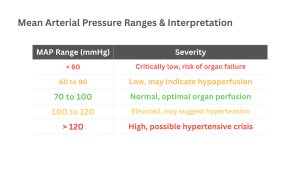
Disclaimer: Diagnosis is usually made clinically. If the score from the MAP Calculator indicates that you might be at risk please consider visiting a doctor for further evaluation. After you calculate the MAP we have a section below that is Mean Arterial Pressure Ranges & Interpretation and is about the clinical classification of the condition you might be.
Note: Please input the values to be greater than 0. You can only input 2 values the DP that is necessary and SP or PP.
What Is Mean Arterial Pressure (MAP)?
The cardiovascular system delivers blood to every part of the body. It is capable of regulating the amount and speed of blood delivered through the veins by reacting to different inputs. The cardiovascular system’s primary function is to guarantee adequate blood flow throughout the body. Blood can be oxygenated through the lungs, and systemic circulation makes sure oxygenated blood and nutrients go to the rest of the body.
The average arterial pressure during one cardiac cycle, including systole and diastole, is known as mean arterial pressure (MAP). Cardiac output and systemic vascular resistance both affect MAP, and each is impacted by a number of different factors. The reason why we described the cardiovascular system is because we are going to provide for you the Mean Arterial Pressure (MAP) Calculator or shorter MAP Calculator that is related to part of cardiovascular system that is the blood pressure. Blood pressure is the pressure of your blood against the artery walls.
Why MAP Matters in Medical Care
Mean Arterial Pressure (MAP) is an important measurement because it reflects patients average pressure during the full process of cardiac cycle. To ensure sufficient blood circulation to important organs like brain, heart and kidneys people need a MAP of at least 60 mmHg. MAP is a crucial metric in both emergency and long-term care settings because if it drops to low it can cause ischemia, hypoxia and possibly lasting organ damage.
Limitation of MAP
Despite the fact that MAP Calculator is an useful tool it also has some limitations. In some clinical situations this tool can be unreliable due to factors such as pulse pressure variability, insufficient autoregulation and wrong blood pressure measurements. Another case is regional blood circulation or in estimating results in certain groups like elderly people. Some conditions like sepsis, shock, or arrhythmias the reliability can be affected. MAP always should be measured along with factors like clinical findings and patients specific facts.
How to Calculate MAP ?
The following formulas are commonly used to estimate the MAP where DP is the diastolic blood pressure, SP is the systolic blood pressure, and PP is the pulse pressure. A sphygmomanometer, also referred to as a blood pressure cuff or monitor, is typically used to measure both diastolic and systolic blood pressure. The below are 2 formulas that are also used in our MAP Calculator. Also, is very easy to use formulas you only need to substitute the DP, SP or PP.
Mean Arterial Pressure Formula
- MAP = DP + 1/3(SP – DP)
- MAP = DP + 1/3(PP)
Explore More Helpful Health Tools
Our website is here to build easy-to-use tools that motivate people to make healthier life decisions and take charge of both their physical and mental well-being. From tools like the MAP Calculator to a wide range of other health calculators, our platform is designed to support your wellness journey.
Below you can explore a few of our tools and more tools are just a search away. If there is a specific test or calculator you need and can’t find, feel free to contact us. We’re always happy to develop new tools that benefit everyone.
Centor Score Calculator – Instantly Check Strep Throat Risk
Quickly estimate your risk of strep throat with this easy-to-use Centor Score Calculator.
NIH Stroke Scale Calculator – Instantly Evaluate NIHSS
Accurately measure stroke severity and guide treatment decisions using the NIH Stroke Scale Calculator.