
Free Water Deficit in Hypernatremia
The Free Water Deficit calculator helps estimate the amount of water a patient needs to correct hypernatremia safely. It guides clinicians in managing elevated sodium levels and preventing complications. Accurate calculation of free water deficit is essential for restoring electrolyte balance and ensuring patient safety.
This calculator is intended for informational and educational purposes only. It should not be used as a substitute for professional medical advice, diagnosis, or treatment. Always consult your healthcare provider.
What is Hypernatremia?
When there is an imbalance between water and sodium in our body causes a condition know as hypernatremia, a condition in which blood sodium levels are unusually high, higher than 145 mmol/L. In simple word there is a water problem due to a lot of water loss because of conditions such as dehydration from excessive drinking, perspiration or diarrhea, and more rarely form high salt consumption.
In cases when the levels increase fast to or above 160 mmol/L, symptoms may include loss of consciousness, confusion, muscular twitches, and extreme thirst and weakness. Blood tests are used for diagnosis, and therapy includes on treating the root cause and gradually correcting the fluid deficiency. Restoring balance and avoiding long-term damage need early detection along with proper treatment.
Common Symptoms of Hypernatremia
- Feeling Very Thirsty: The body’s strongest signal that it needs more water.
- Weakness or Tiredness: You can feel exhausted, low in energy, or abnormally sleepy.
- Confusion or Trouble Thinking Clearly: Dehydration in the brain can make it hard to concentrate or stay alert.
- Muscle Issues: Muscles may fell twitch, cramp, or weak.
- Irritability and Restlessness: It can lead to fussiness, agitation, or difficulty sleeping, particularly in young kids and babies.
Main Causes of Hypernatremia
- Too Much Water Lost : In conditions like vomiting, diarrhea, or stomach drainage, sweating from heat or exercise and excessive urination.
- Too Much Sodium: Eating or receiving very salty foods or fluids or in hospital treatments with high-salt IV fluids.
- Not Enough Water Intake: Can’t drink enough water, being thirsty or short supply of water.
What is Free Water Deficit?
Free Water Deficit (FWD) is the quantity of water that our body has lost that results in high blood sodium (or hypernatremia). It is helpful in directing fluid intake to fix cellular dehydration and return sodium levels to normal. FWD happens when our body losses water but keeps sodium and this condition when water to leave the cells its caused reduction. Some of the main causes are also listed in the Main Causes of Hypernatremia like vomiting, sweating, etc.
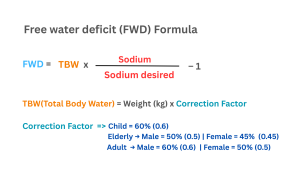
In order to treat hypernatremia safely and avoid problems, it is crucial to calculate the FWD. Correcting the deficiency can also help in the reduction of symptoms such as weakness, disorientation, and in extreme situations, seizures or coma. Below you have an image that includes the formula and the neccesary components to calculate Free water deficit.
Step-by-Step Example Calculation
Patient details
- Gender: Male
- Age Range: Elderly
- Weight: 70 kg
- Sodium : 155 mmol/L
- Sodium desired : 140 mmol/L
Step-by-Step Calculation
- TBW = Weight x Factor = 70 * 0.5 = 35 L
- Free water deficit = TBW x ((Sodium / Sodium desired) -1)= 35 x ((155 / 140) -1) = 3.75 L
Clinical Importance of Calculating Free Water Deficit
Free Water Deficit Calculation must be done for safely treating hypernatremia (condition that results in elevated blood sodium). This calculation helps health care providers to evaluate exactly how much water is required to rehydrate the body and return salt levels to normal. By using free water deficit calculator major issues like cerebral edema are avoided, which might happen if correction is made too quickly.
Also, it specifies the safe rate of fluid replacement, which is normally between 10 and 12 mEq/L per day. Doctors may modify treatment by taking into consideration patients specific characteristics such as renal function, continuous fluid losses, and total volume status. Fluid deficit calculation minimizes the danger during correction and guarantees efficient management of dehydration.
Limitations of the Free Water Deficit
Estimating a free water deficit has limits since it depends on assumptions about total body water and typical sodium levels, which might vary across individuals. Because our bodies contain electrolytes and the calculation does not account for continuous fluid gains or losses, it frequently underestimates overall water loss. It must be read in considering the patient’s entire clinical history, as it simply offers an prediction.
Using the method alone to make quick corrections might be risky and may result in seizures or cerebral edema. It is crucial to constantly evaluate symptoms of illness, urine production, and serum salt levels. To ensure safe and efficient treatment, doctors should use the calculation in along with regular laboratory testing and patient evaluation.
Take Control of Your Health with More Tools
Our website is here to provide easy-to-use tools that help you make healthier life choices and take better care of your body and mind. We offer a variety of health calculators, like the Free Water Deficit Calculator, to support your well-being.
Below you’ll find some of our tools, and many more are just a quick search away. If you don’t see the test or calculator you need, feel free to contact us—we’ll be happy to create it for you and others.
Serum Anion Gap Calculator
Quickly identify and assess potential acid–base imbalances.
FENa Calculator
Instantly evaluate the fractional excretion of sodium to aid in kidney function assessment.