
Cardiac Output Calculator (Fick’s Formula)
The Cardiac Output Calculator (Fick’s Formula) helps estimate the heart’s pumping efficiency by calculating the volume of blood the heart delivers per minute. It is commonly used in clinical settings to assess cardiac function and guide treatment decisions. Accurate cardiac output measurement is essential for managing critically ill patients and optimizing medical treatment.
Cardiac Output calculator is intended for informational and educational purposes only. It should not be used as a substitute for professional medical advice, diagnosis, or treatment. Always consult your healthcare provider.
What is Cardiac Output?
The volume of blood that is pumped out per 1 minute is know as cardiac output, that is calculated by the hearts rates time stroke volume. In healthy patients the CO is around 5L/min when they are resting and when they are active it increases rapidly. Vascular resistance, stroke volume, and heart rate all have their impact. Preload, afterload, contractility, and autonomic control are important parameters that affect CO.
Maintaining blood flow to important organs, reacting to the body’s periodic requirements, and acting as a crucial indicator of heart function all depend on CO. Heart disease or other cardiovascular conditions may be detected through abnormal cardiac ouput levels. Having a check on CO during surgery and in severely sick patients helps direct treatments.
Clinical Importance of Measuring Cardiac Output
In order to evaluate heart function, direct treatments, and make sure tissues receive enough oxygen, cardiac output measurement is essential. It supports directed therapy, supports in the differentiation of different forms of shock, and tracks the successful outcome of treatments like medicine or fluids. CO measurement determines tissue perfusion and exercise capability, helps diagnose and treat heart disease, and offers direct insight into cardiovascular health. In severely sick patients, cardiac output monitoring provides a more accurate estimate of the heart’s pumping capacity than clinical examination alone.
Overview of the Fick Principle
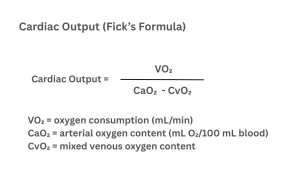
The Fick Principle uses a substance like oxygen to evaluate blood flow, which often is cardiac output. Blood flow is evaluated the rate at which the substance is taken in or released is divided by the difference in its concentration between venous and arterial blood. The formula which will be shown below must be used to measure oxygen consumption (VO₂), arterial oxygen content (CaO₂), and venous oxygen content (CvO₂).
It may be used for substances other than oxygen and is based on the law of conservation of mass, making it the preferred method for measuring cardiac output. While precise method of evaluation, it usually involves invasive sample techniques like catheterization. Doctors are able to better evaluate tissue perfusion and cardiac function because to this concept. In critically sick patients, it also helps guide treatments and diagnose cardiovascular diseases.
Clinical Significance of the Fick Principle
This principle give the opportunity to healthcare providers to evaluate the ability of the heart to pump blood per minute and to calculate the cardiac output. It is a crucial method to identify problems that involve systemic-to-pulmonary shunts, determining regional blood flow, including renal perfusion, measuring exercise capacity, identifying kinds of shock, and directing treatments of critically ill patients. It helps doctors make better decisions and provide the best care by giving accurate information about blood flow, especially in complex or special cases.
Advantages of the Fick Method for Cardiac Output Measurement
The Fick formula is known as the “gold standard” for assessing cardiac output because of the high accuracy in cases like irregular heart rhythms or in low-output states.It is reliable for research, checking other methods, and certain medical tests like diagnosing pulmonary hypertension because it is based on the basic principle of mass conservation. Although it requires invasive procedures and skills, it gives very accurate blood flow information. This precision helps doctors make better decisions and provide the best care in serious or complicated situations.
Limitations of the Fick Method
The Fick methods is very accurate and useful tool but it hass some limitations. It requires regular oxygen usage, requires an invasive catheter technique, and at times requires estimated values that can lead to errors. Results may be less accurate if there are issues such as heart problems, elevated lung oxygen use, small variations in blood oxygen levels, or fast hemoglobin shifts. As a result, it is not appropriate for constant monitoring and might not be effective in individuals who are extremely ill or unstable. It is mostly used to handle unique situations when accurate measurement is crucial.
Explore More Helpful Health Tools
Our website is here to create tools that help people to make better life choices and having your body and mind in control. We provide a range of health related tools like the Cardiac Output Calculator designed to support your well-being.
Below you will find a couple of them and much more that are just a search away . If you don’t find any specific test or calculator you’re looking for please feel free to contact-us so we can create it for everyone. ‘
Free Water Deficit in Hypernatremia
Calculates the amount of water a patient needs to correct high sodium levels in the blood.
Fibrosis-4 (FIB-4) Index for Liver Fibrosis
Estimates liver scarring using age, liver enzymes, and platelet count.