
Caprini Score (2005) for Venous Thromboembolism
The Caprini Score (2005) is a widely used tool to assess a patient’s risk of developing venous thromboembolism (VTE), including deep vein thrombosis and pulmonary embolism. It helps clinicians decide on appropriate preventive measures. Early risk assessment with the Caprini Score can significantly reduce complications and improve patient outcomes.
Caprini Score calculadora is intended for informational and educational purposes only. It should not be used as a substitute for professional medical advice, diagnosis, or treatment. Always consult your healthcare provider.
What is Venous Thromboembolism (VTE)?
A blood clot that develops in the veins, usually as pulmonary embolism (PE) or deep vein thrombosis (DVT), is known as venous thromboembolism (VTE). Worldwide this conditions is leading cause for deaths in hospitals that could be prevented. Some of the main causes of the illness that raise the chances for development of colt are cancer, surgery, genetic factors and immobility. If VTE is not identified in early stages it can result in serious side effects such as chronic venous insufficiency or in cases with pulmonary embolism it can be fatal. The lower the danger of VTE it is important to check early risk assessment and taking the treatment on time.
Risk Factors for VTE?
Some of the main risk factors of VTE are severe surgery and trauma, cancer and its therapies, history of earlier colts and long periods of immobility. The risk can also be increased by other health conditions, such as renal disease, diabetes, heart disease and inflammatory bowel disease. Daily habits or lifestyle habits like smoking, obesity, traveling for long distances have their impact and also hormonal impact such as pregnancy, birth control and hormone treatment have their effect. The chance is significantly raised by family history and inherited clotting problems. After the age of 40, the risk almost doubles every ten years.
Why Risk Assessment is Important
In order to evaluate the patients who are at a higher risk of blood colts in some of the conditions we provided before like immobile or have done surgery, VTE risk assessment is very essential. It supports healthcare providers in avoiding useless treatments for low-risk patients while providing focused preventative care, such as early mobilization or anticoagulants. This lowers the number of deaths from VTE, improves the cost-effectiveness of medical care, and improved safety by achieving a balance between bleeding risks and clot prevention. Also it promotes patient safety attempts, coordinates treatment, and raises the level of healthcare in general.
What is the Caprini Score for Venous Thromboembolism (2005)?
Caprini Score (2005) is an risk evaluation tool used to determine the risk of venous thromboembolism (VTE), especially for surgical patients who receive treatment to the hospital. The Caprini score has a range from 0 to 5 points for each components that its assigned based on the risk. Each score is evaluated with a risk score from low to the highest that includes factors like age, cancer, surgery, etc.
The treatment to prevent blood clots is chosen based on your risk level and can include things like getting you moving quickly after surgery or using blood thinners and compression devices. Caprini Score should be reviewed when patient conditions change since it supports doctors in finding a balance between the dangers of anticoagulant medication and successful clot prevention.
Components of the Caprini Score
The components below are some of the main ones of the Caprini score. You can see all of the to one of our references at the end of page or at our Caprini Score Calculator.
- Type of surgery
- CHF
- Stroke
- Varicose veins
- Current swollen legs
- Family history of thrombosis
- History of DVT/PE
- Mobility
- BMI >25
- COPD
- Other risk factors
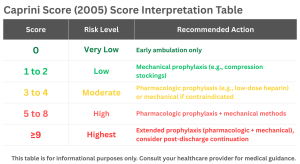
Clinical Application of the 2005 Caprini Score
The Caprini Score is used to assess a patient’s risk of venous thromboembolism (VTE), including deep vein thrombosis (DVT) and pulmonary embolism (PE), mainly in surgical and hospitalized patients. To determine the risk level of the patients from low to very high risk, doctors count points based on factors including age, weight, medical history, and treatment type.
With the risk of bleeding in mind, this score allows in selecting the most effective ways to prevent it, such as medication used for blood thinning or combining the methods to use. Since the patient’s risk might vary while receiving medical care, it should be evaluated on a regular basis. In order to keep patients safe and prevent clots during operations and other medical problems, the Caprini Score is frequently used.
Advantages of the Caprini Score
A proven method for determining VTE risk, especially in surgical patients, is the Caprini Score. It enables doctors to customize preventative treatments to each patient’s specific danger level. Millions of patients have gone through deep examination, guaranteeing accurate risk classification and better patient outcomes by lowering hospital-acquired VTE, morbidity, and death.
The score offers greater prediction accuracy than other measures since it considers a wide variety of risk factors, above simple factors such as family history, recent trauma, and kind of operation. Its flexibility makes it possible to regularly evaluate a patient while they are in the hospital, ensuring that prophylaxis is still appropriate. In practice, the Caprini Score helps standardize how VTE prevention is done, makes it easier for healthcare teams to communicate, identifies high-risk patients who need extended treatment, and can be added to electronic medical records to ensure guidelines are followed.
Limitations of the Caprini Score
The Caprini Score has some limitations despite being a widely used tool for evaluating VTE risk. Its accuracy in medical or non-surgical populations varies because it was created for surgical patients. Predictive accuracy does not separate between PE and DVT, and it varies with expertise. With over 39 risk factors, the score can be complicated and time-consuming, and it doesn’t take individual bleeding risk into consideration. Its practical use may be more limited by poor implementation, incorrect EHRs, and specific processes that automatically provide high results.
Discover More of What We Offer
Our website is here to provide easy-to-use tools that help you make healthier life choices and take better care of your body and mind. We offer a variety of health calculators, like the Caprini Score Calculator, to support your well-being.Below you’ll find some of our tools, and many more are just a quick search away. If you don’t see the test or calculator you need, feel free to contact us—we’ll be happy to create it for you and others.
COPD Assessment Test (CAT)
A simple questionnaire that measures the impact of COPD on a patient’s daily life and wellbeing.
Corrected Reticulocyte Percentage(RPI)
A calculation used to assess bone marrow response and red blood cell production in anemia.