
APACHE 2 Score
The APACHE II Score is a tool doctors use to measure how sick a patient is in the intensive care unit (ICU). It looks at things like vital signs, lab results, age, and other health problems. This helps doctors understand the patient’s condition and estimate their chances of recovery.
APACHE Score calculator is intended for informational and educational purposes only. It should not be used as a substitute for professional medical advice, diagnosis, or treatment. Always consult your healthcare provider.
Introduction to APACHE II
The APACHE II (Acute Physiology and Chronic Health Evaluation II) score is a medical method used in ICU (intensive care units) for evaluating the severity of patients sickness and estimate the probability of mortality. The method is based on 12 physiological parameters, the patient’s age, and any current chronic medical illnesses, that gives a score ranging from 0 to 71 points, with higher score estimating a more serious illnesses.
The Apache 2 score is commonly used to compare the quality of medical treatment among ICUs, separating patients into different risk categories, estimating results, and guiding resource allocation by identifying patients who may be safer to transfer to less intense care. It helps healthcare providers in tracking changes in patients conditions over time and in making well-informed medical treatment decisions.
History and Development of APACHE 2 Score
The APACHE II score was created in 1985 by Dr. William Knaus and his crew at George Washington University Medical Center as the simpler and useful version of the original APACHE I system. Its purpose was to estimate the hospital mortality and categorize the level of severity of the illness in critically sick intensive care unit patients. APACHE score was derived from more than 5000 patients medical data, added age and chronic health status to a total score that ranged from 0 to 71 by reducing the number of assessed variables from 34 to 12. It was widely used in clinical practice and research around the world because to its ease of use, accuracy, and great predictive power.
Clinical Applications of APACHE Score
In intensive care unit the apache score is commonly used to evaluate the severity of patients sickness and mortality prediction. In clinical terms, it helps in risk classification in studies, prognosis estimate, and assessment of ICU performance and care quality. By detecting low-risk patients who may be safely moved to less intensive care facilities, it also helps with resource management. The apache score is a crucial tool for patient care and healthcare planning as it compares results across various intensive care units and helps guide clinical decisions based on age, chronic health status, and physiological data.
APACHE Score Interpretation Table
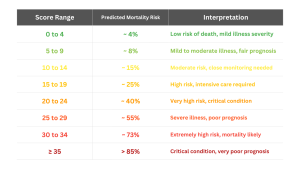
Components of APACHE II
Acute Physiologic Variables (12 parameters):
- Temperature
- Mean Arterial Pressure
- Heart Rate
- Respiratory Rate
- Oxygenation (PaO2 or A-a gradient)
- Arterial pH
- Serum Sodium
- Serum Potassium
- Serum Creatinine
- Hematocrit
- White Blood Cell Count
- Glasgow Coma Scale (GCS)
Age: Points are added based on age, older patients get higher points.
Chronic Health Points: This part looks at long-term illnesses (like heart, liver, or kidney disease) that may affect recovery.
Advantages of APACHE II
In critical care, the APACHE 2 Score has lots of important benefits, including as better patient outcome prediction, daily tracking of illness development, and early identification of high-risk patients. It is a useful method for directing medical treatment choices, effectively gathering ICU resources, and improving the standard of care due to its ease of use and clinical precision. Also, it enables improved patient data management for research and healthcare payment systems, improving administrative and clinical decision-making. Its uniform scoring system makes it simpler to evaluate patient outcomes and treatment procedures across hospitals by maintaining consistency in ICU evaluations.
Limitations of APACHE II
APACHE score come along with some limitations such as limiter sensitivity when used at intensive care unit admission, difficulties evaluating patients with multiple chronic illnesses, and decreased accuracy for trauma patients. Changes in the patient population and the impact of medical procedures on physiological data might potentially cause its reliability to decline over time. Complex calculations and subjective judgments can sometimes cause scoring mistakes. Newer approaches, such as APACHE IV and SAPS II, are now recommended for more precise estimation and ICU performance evaluation because of these problems.
FAQs for APCHE II Score
How does APACHE 2 differ from newer scoring systems like APACHE IV or SOFA?
APACHE II looks at a patient’s first 24 hours in the ICU to estimate illness severity. It’s simple but static. Newer scores like APACHE IV and SOFA can track changes over time, making them better for monitoring progress and predicting outcomes.
Is a high APACHE 2 score always an indicator of a poor outcome?
Not necessarily. A high score means that patients with similar scores tend to have a higher risk of death, but it doesn’t predict exactly what will happen to one person. Each patient’s recovery depends on many things, like how they respond to treatment or other health problems they may have.
Can the APACHE 2 score be used for pediatric patients?
No. The APACHE II score is meant for adults (16 years and older). Children’s bodies respond differently to illness, so doctors use special pediatric scoring systems instead
Does the score account for the patient’s primary diagnosis?
Yes. When predicting outcomes, the APACHE II score is often combined with the main diagnosis that brought the patient to the ICU. This helps make the prediction more specific and accurate for that particular condition.
What is the Glasgow Coma Scale (GCS) part of the calculation?
The GCS measures how awake and responsive a patient is. In the APACHE II score, it helps show how the brain is functioning. A perfect score (15) means the person is fully alert. Lower GCS values add more points to the APACHE II score, meaning worse brain function.If a patient is sedated or paralyzed, doctors assume the GCS is normal.
What is the purpose of the APACHE score in research?
Researchers use the method to group patients by how sick they are. This helps compare outcomes between hospitals, treatments, or studies in a fair way. For example, they can test if a new therapy works better for patients with similar severity of illness.
How do hospitals use the APACHE II score internally?
Hospitals sometimes use it to see how sick their ICU patients usually are and to track their results over time. This helps them monitor performance, improve care, and make sure their ICU is providing good quality treatment.
How is the APACHE 2 score affected by acute renal failure?
If a patient has acute kidney (renal) failure, the points for their creatinine level are doubled in the score. This gives more weight to kidney problems, since they make the illness much more serious.
Can the APACHE II score predict a patient’s length of stay in the ICU?
Not exactly. Patients with higher scores often stay longer in the ICU, but the APACHE II score mainly predicts mortality, not how long someone will need care. Many other factors, like treatment success or complications, affect how long a patient stays.
Explore More Helpful Health Tools
We develop tools to help you take control of your well-being and make informed life choices. Explore our range of health resources, including our APACHE Score Calculator , designed to support your mental and physical health.
Below you will find a couple of them and much more that are just a search away . If you don’t find any specific test or calculator you’re looking for please feel free to contact-us so we can create it for everyone.
SOFA Score Calculator
A tool to assess and track organ function in critically ill patients.
Glasgow Coma Scale
A quick measure of a patient’s level of consciousness and neurological function.