
APRI Score – AST to Platelet Ratio Index
The AST to Platelet Ratio Index (APRI) is a simple, non-invasive test used to assess liver fibrosis and cirrhosis, especially in patients with chronic hepatitis B or C. It combines two routine blood test values, aspartate aminotransferase (AST) and platelet count, to estimate the level of liver damage. The APRI score calculator helps clinicians decide if further diagnostic tests or liver biopsy are needed.
APRI Score Calculator is intended for informational and educational purposes only. It should not be used as a substitute for professional medical advice, diagnosis, or treatment. Always consult your healthcare provider.
Overview of Liver Fibrosis and Its Assessment
The The buildup of scar tissue in the liver brought on by persistent damage from conditions like fatty liver disease, alcoholism, or viral hepatitis is known as liver fibrosis. If the root problem for the cause is determined, it is usually treatable in early stages. Evaluation seeks to estimate the existence and stage of fibrosis by using either one of invasive methods such liver biopsy or non-invasive methods like blood-based tests (such APRI and FIB-4) and imaging techniques like FibroScan or MRI elastography. For better an improved long-term liver health and to stop the growth of cirrhosis, early detection and routine monitoring are crucial.
Limitations of Liver Biopsy
Liver biopsy despite being considered the gold standard for determining fibrosis it has some limitation. As an invasive method it has some possible risks like organ injury, bleeding, and pain, which makes some patients not willing to do it. The interpretation of small liver sample might not be able to provide the full overview of the liver condition. The same biopsy may be interpreted differently by various healthcare providrs, which might have an impact on the diagnosing and outcome. These problem have led in using non-invasive methods that are safer and simpler tests such as APRI, FIB-4, and elastography are now often used instead of or alongside, a biopsy.
Emergence of Non-Invasive Biomarkers for Liver Fibrosis
Without the need for a biopsy, non-invasive biomarkers have become crucial methods for identifying and tracking liver fibrosis. These include imaging techniques like transient elastography (FibroScan) and blood-based tests like FIB-4 and ELF, which are less expensive, safer, and simpler to repeat and be done. These methods can be used and combined to improve the accuracy, lowering sample mistakes and provide constant monitoring. The goal of current and future research is to create more accurate non-invasive biomarkers, like some based on mircoRNAs, so they can have a more accurate evaluation and direct medical treatment.
What is the AST to Platelet Ratio Index (APRI)?
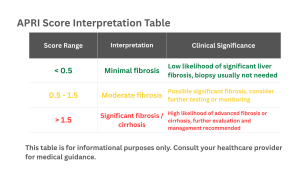
AST to Platelet Ratio Index (APRI) is a non-invasive blood test that is used to determine the liver cirrhosis and fibrosis. The score evaluates liver damage by using 2 standard laboratory values that are platelet count and aspartate aminotransferase (AST). It is a helpful method for evaluating liver function in diseases like hepatitis and other chronic liver diseases because if the score is high it shows a more severe liver condition. This method is generally used due to being easy to use, being a cheap tool, and that provides quick results that assist in helping guiding medical treatment and further evaluation.
Clinical Applications of APRI Score
APRI score as we mentioned is non-invasive method, cost-effective tool for evaluating cirrhosis and fibrosis, especially in patients with chronic hepatitis C and NAFLD. It helps healthcare providers in monitoring and checking for liver scarring, preventing and reducing unnecessary liver biopsies, and sometimes in identifying heart related risks. It performs best when combined with additional tests and interpreted according to the particular liver problem. Also, it offers a helpful method for determining if a patient can benefit frim immediate intervention or needs closer monitoring.
Advantages of APRI score
As we have told throughout the article that is non-invasive method, cost-effective blood test and that helps in determining the liver fibrosis and cirrhosis, this are some of the main advantages of the score. Also, it is simple to use, widely available and can be repeatable often to track the course of the disease. It can be especially helpful in cases like chronic hepatitis C and nonalcoholic fatty liver disease (NAFLD) and lowers the demand for liver biopsies by properly evaluating patients. It also gives medical providers a reliable tool for the early evaluation and continuous medical treatment of liver disease.
Limitations of APRI score
The AST to Platelet Ratio Index score beside being a useful methods it comes along with some limitations. It has a low sensitivity and accuracy in detecting cirrhosis, its positive predictive value is modest and some of the patients may remain undiagnosed. Acute infections or non-liver problems might change platelet counts or AST, which could lead to results that are incorrect. The score results should be looked alongside with other medical data, because the low scores are more reliable in showing that a patients does not have cirrhosis, and a high one is less realiable in confirming if patients have cirrhosis.
FAQs for AST to Platelet Ratio Index (APRI)
Is the APRI score a definitive diagnosis for liver fibrosis?
No. The score only helps estimate liver damage, it’s not the final diagnosis. Doctors use it as a screening tool, along with other tests and medical information. If your result is unclear, your doctor may suggest more accurate tests like FibroScan or a liver biopsy.
Can conditions other than liver disease affect my APRI score?
Yes. Some health issues can raise AST or lower platelet levels, which changes your score result. Examples include conditions like acute illness, muscle problems, heavy alcohol use, and other blood disorders.
How do antiviral treatments for hepatitis affect the APRI score?
When hepatitis treatment works, the APRI score usually goes down because the liver heals and AST levels drop. Platelet counts may also rise. However, a lower score doesn’t always mean all liver damage is gone, some scarring may still remain.
Is APRI more accurate for some liver diseases than others?
Yes. The APRI test works best for hepatitis C, but it’s less accurate for other liver diseases like fatty liver (NAFLD), autoimmune hepatitis, or alcohol-related liver disease.
How does APRI compare to other non-invasive tests like FIB-4?
Both APRI and FIB-4 are easy and cheap ways to check for liver scarring using blood tests. FIB-4 also includes your age and may be a bit more accurate for advanced liver disease. Doctors often use both tests together for better results.
What is the role of transient elastography (FibroScan) in relation to APRI?
FibroScan is a more precise test that checks how stiff your liver is. It’s often done after a high APRI result to confirm liver damage. Think of APRI as a first check, and FibroScan as a follow-up to get a clearer picture.
How often should my APRI score be monitored?
It depends on your health and doctor’s advice. People with liver risks may need testing every few months to every couple of years. If your score stays high, your doctor might order ultrasound or FibroScan for more details.
Do I need to fast before getting an APRI blood test?
You usually should follow your doctor’s fasting advice before the blood test. Fasting is sometimes needed if your doctor orders other tests at the same time (like cholesterol), since food can affect those results.
What does it mean if my APRI score fluctuates?
Changes in your APRI score can happen due to treatment, temporary inflammation, or lab variations. Your doctor will look at how your score changes over time to see if your liver is getting better or worse.
Can a high APRI score get better with lifestyle changes?
Yes. Healthy habits can improve your liver and lower your APRI score. Reducing alcohol, losing weight, and exercising regularly can help your liver recover and make your test results better over time.
Explore More Helpful Health Tools
We develop tools to help you take control of your well-being and make informed life choices. Explore our range of health resources, including our APRI Score Calculator , designed to support your mental and physical health.
Below you will find a selection of our tools, with many more available on our site, just a search away. If a specific tool is missing, please contact us, we’d love to create it for you and everyone else.
Fibrosis-4 (FIB-4) Index for Liver Fibrosis
A non-invasive calculation that estimates liver scarring using age, liver enzymes, and platelet count.
Free Water Deficit in Hypernatremia
A formula used to estimate how much water the body has lost in cases of high blood sodium levels.