Glasgow Coma Scale (GCS Score)
The Glasgow Coma Scale (GCS) is a clinical tool used to assess a patient’s level of consciousness after a head injury or in critical care. Use our easy-to-use GCS calculator to quickly determine the score based on eye, verbal, and motor responses. Ideal for healthcare professionals and students for fast, accurate assessments.
GCS Sore Calculator is intended for informational and educational purposes only. It should not be used as a substitute for professional medical advice, diagnosis, or treatment. Always consult your healthcare provider.
Note: Select “Not Testable (NT)” if a response cannot be assessed due to medical reasons, such as intubation, sedation, or severe injury.
What is Level of Consciousness (LOC) in Healthcare?
Level of Consciousness (LOC) points to the patients level of attention and awareness for both the environment around them and theirself. Changes related to LOC can be early indicators for severe brain damage or any other medical disease. The main causes may be both structural and toxic metabolic. Structural causes can be conditions such as trauma, tumors, stroke, and bleeding, for toxic-metabolic are medication side effects, glucose imbalance, infections, and organ failure.
Because describing consciousness can be subjective and unclear, healthcare providers use methods that measure factors like eye opening, verbal response and motor response. Based on these parameters of response the Glasgow Coma Scale is method that assists in defining the degree of impaired consciousness. LOC may have different from like slight lethargy to severe coma.
Challenges in Assessing Consciousness
Evaluating consciousness its challenging since it includes both subjective experience and observable activities. Clinically, relying just on nonverbal signals such as eye movements, voice, or motor responses can be inaccurate, particularly in patients with motor or sensory impairments, arousal fluctuations, or drug side effects. Consciousness indicators might change over time, requiring further testing. There are no widely accepted brain-based signals, current instruments are imprecise, and neuroimaging is still limited and occasionally inconclusive. These challenges point to the importance to have more accurate and theory-based methods, which also lead to frequent diagnostic mistakes and significant ethical issues.
Role of LOC in Traumatic Brain Injury (TBI)
Loss of consciousness (LOC) is an important indicator for the severity of TBI. It indicates a greater risk fir long-term neurodegenerative diseases, persistent cognitive or psychiatric symptoms, and structural brain abnormalities. LOC assists doctors in determining the severity of injuries, perform neuropsychological and neuroimaging examinations. Also, it helps doctors in providing recovery treatment planning, including safe return-to-activity decisions, especially in sports. To have better medical treatment and outcomes, must be determined and documented as soon as possible.
What is the Glasgow Coma Scale (GCS)?
Glasgow Coma Scale (GCS Score) is a method used to measure patients state of awareness by analyzing their eye opening, verbal and motor response. GSC score offers to healthcare providers a rapid and accurate method to explain patients neurological condition. To each of the factors is given a score and the sum of these scores ranges from 3 points that is determined as deep coma to 15 points that indicates totally aware.
These GCS scale helps in accessing the degree of brain damage, tracking changes in neurological condition, and directing options for treatment. It is generally accepted across the world and is crucial for both research as well as clinical evaluation. Also, is used to treat stroke, non-traumatic coma, and other disorders that impact consciousness and was first created for traumatic brain injury (TBI).
Components of GCS Score
- Eye Opening (E): Measures how eyes open in response to stimuli.
- Verbal Response (V): Assesses clarity of speech and orientation.
- Motor Response (M): Evaluates muscle movement and response to commands or pain.
How It’s Used GCS Score in Clinical Practice
By evaluating eye-opening, verbal, and motor responses, GCS scale provides an objective measurement of a patient’s state of consciousness. It helps healthcare provides a reliable method for determining and accurately communicating the neurological state. GCS score is used for conditions like traumatic brain injury, stroke, non-traumatic coma, cardiac arrest, and CNS depressant cases to evaluate illness, track changes, and direct medical treatment. Also, it assists in diagnosis and treatment planning, tracking patient progress, predicting problems, and classifying the severity of injuries.
Advantages Glasgow Coma Scale (GCS scale)
GSC scale provides a number of advantages, such as standardized evaluation for uniform communication between medical providers, being able to rapidly and accurately assess verbal, motor, and visual responses. Also, it has the capacity to monitor changes in a patients neurological condition over time. It is a reliable method in emergency and critical care because it assists in predicting injury severity and outcomes. It can be used in many clinical situations, gives clear information about each part of the assessment, is low-cost, and easy to use.s
Limitations of GCS Score
Beside being a useful and very used tool the GCS score comes along with some limitations. In cases where the patient is intubated or those with speech, vision, or hearing impairments it cant fully access them and evaluate. Also, in some other cases like facial trauma, spinal cord injury, or sedation it cant be very reliable. The GSC scale doesn’t evaluate neurological changes or brainstem reflexes, and interrater reliability may be low. It has low accuracy in predicting for individual patient outcomes and is less accurate for young children and those in the score range 9–12. In some situations, like language barriers and other complicating factors can make the GCS less accurate in some medical situations.
FAQs for Glasgow Coma Scale (GCS)
What is the scoring range of the GCS?
The GCS score ranges from 3 to 15. The highest possible score is 15, indicating full consciousness, while the lowest possible score is 3, indicating deep coma or death.
What do the different GCS scores mean?
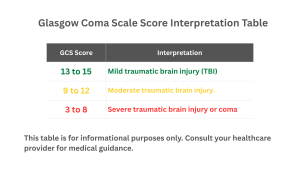
A higher score indicates a higher level of consciousness. The scores are often categorized for traumatic brain injuries (TBI) like mild, moderate and Severe TBI. A score of 8 or less typically indicates a coma.
How are the GCS components scored?
Each of the three components has its own scoring system:
- Eye-opening: Scored from 1 to 4.
- Verbal response: Scored from 1 to 5.
- Motor response: Scored from 1 to 6.
How do you interpret the specific scores of each component?
The highest score in each category indicates the best response. For the full scoring breakdown of eye, verbal, and motor responses, please refer to the referenced web in reference section in the end.
What is the significance of a GCS score of 8 or less?
A score of 8 or lower suggests a severe head injury and brain dysfunction. Patients with this score may need airway support.
Is the GCS only for brain injuries?
No, the GCS is used in various acute medical and trauma situations to assess neurological status, not just for brain injuries.
Can GCS be used for children?
The standard GCS is not suitable for very young children and infants. The Pediatric GCS was created specifically to assess their consciousness level.
More Tools to Support Your Health
Our website is dedicated to providing tools that empower you to make informed health choices and take control of your body and mind. We offer a variety of health-related calculators, including the GCS Calculator, to support your overall well-being.
Explore the tools below and many more, just a search away. If you don’t find a specific test or calculator, feel free to contact us, and we’ll be happy to create it for everyone.
Revised Trauma Score (RTS)
A rapid scoring system used to assess trauma severity and predict patient survival.
Critical Care Pain Observation Tool (CPOT)
A tool to evaluate pain in critically ill patients who cannot communicate verbally.