
Dermatology Life Quality Index (DLQI Score)
The Dermatology Life Quality Index (DLQI) is a widely used questionnaire designed to measure the impact of skin conditions on a patient’s quality of life. It evaluates how skin problems affect daily activities, emotions, work, and social interactions over the past week. By providing a standardized score, the DLQI helps clinicians assess disease burden and guide treatment decisions.
DLQI score calculator is intended for informational and educational purposes only. It should not be used as a substitute for professional medical advice, diagnosis, or treatment. Always consult your healthcare provider.
What is the DLQI?
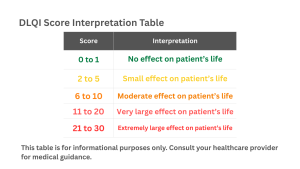
Dermatology Life Quality Index (DLQI) is a questionnaire that consist in 10 question, was created at Cardiff university to estimate the patients skin impacts their everyday life, social interaction with people and the general well0being. This questionnaire is done by patients privately, and it is focused on the previous week symptoms from which is calculated a score ranging from 0 to 30 points. Higher scores indicates a bigger impact.
This tool is the most popular patient-reported outcome method in dermatology for clinical use or practice and researches. DLQI score has been used in more than 80 countries, and also translated into a lot other languages. It ensures that treatment strategies go beyond visible symptoms by giving doctors a deeper understanding of the patient’s viewpoint. It has grown into an important connection between clinical evaluation and the actual experiences of those with skin disorders throughout time.
Who Can Use It?
The DLQI is created for persons with skin problems who are 16 years of age or older. Patients fill out a quick, self-administered questionnaire to explain how their skin condition affects their daily lives, and doctors use the answers to inform treatment choices and track advancement. It gives an accurate understanding of the patient’s quality of life by measuring effects across symptoms, everyday activities, relationships, work, leisure, and therapy. DLQI Score provides a greater understanding of the patient’s condition by documenting both the physical and emotional components.
Questions included in DLQI score?
For each of the question are four options to answers and for each of them is score that ranges from 0 to 3 points. Also, when the DLQI score is finished the sum of points ranges from 0 to 30 points and after the components you will have the scoring range interpretation table.
- Over the last week, how itchy, sore, painful or stinging has your skin been?
- Over the last week, how embarrassed or self-conscious have you been because of your skin?
- Over the last week, how much has your skin interfered with you going shopping or looking after your home or garden?
- Over the last week, how much has your skin influenced the clothes you wear?
- Over the last week, how much has your skin affected any social or leisure activities?
- Over the last week, how much has your skin made it difficult for you to do any sport?
- Over the last week: (a) Has your skin prevented you from working or studying? => (b) If “No”, how much has your skin been a problem at work or while studying?
- Over the last week, how much has your skin created problems with your partner or any of your close friends or relatives?
- Over the last week, how much has your skin caused any sexual difficulties?
- Over the last week, how much of a problem has the treatment for your skin been (e.g., time, messiness, inconvenience)?
Why is the DLQI Important?
DLQI score is one of the most used methods to measure patients self-evaluation outcome in dermatology, and provides a consistent way of determining the impact of skin conditions on quality of life. It is useful for clinical treatment and research as it records patient viewpoints on symptoms, feelings, everyday activities, and relationships. Researchers make it as a standard in clinical studies, and clinicians use it to inform treatment choices and track outcomes. By doctors and researchers is used widely to measure how skin conditions effects patients life.
Limitations of DLQI
Dermatology Life Quality Index come with some limitations such as effect by age, gender, and cultural factors, trouble measuring emotional effect, insensitivity to minor illness, a lack of questions about sleep, and an underestimating of impact as a result of “not relevant” answers. There are a few general criteria that the score may not be compared across different populations or skin conditions, and clear guidelines for what counts as an important change are limited. It is still a commonly used tool for evaluating dermatological patients’ quality of life in despite of these limitation.
Practical Uses in Clinical Practice
By guiding treatment decisions and tracking the results of the treatment over time, the score supports doctors in understanding the practical effects of skin disorders on patients. In along with offering a systematic, rapid, and accurate way to evaluate changes in quality of life and assess treatment effectiveness. Also, enables patients to express how their illness impacts everyday activities, emotions, employment, and relationships. With consistent patient-reported outcomes for comparing medicines and monitoring treatment improvements, it is also a helpful tool in clinical research and health technology evaluations.
FAQs for Dermatology Life Quality Index
Who can use the DLQI?
The DLQI can be used by clinicians, researchers, pharmaceutical companies, and students. It is intended for routine clinical purposes to assist in consultations, evaluations, and decision-making processes.
How long does it take to complete the DLQI?
On average, the DLQI takes about two minutes to complete. It is a self-administered questionnaire, making it user-friendly and efficient.
In how many languages is the DLQI available?
The DLQI has been translated into over 140 languages, making it accessible for use in more than 80 countries.
Can the DLQI be used for children?
No, the DLQI is specifically designed for adults aged 16 and over. For children, a modified version called the Children’s Dermatology Life Quality Index (CDLQI) is used.
More Tools to Support Your Health
Our website is dedicated to providing tools that empower you to make informed health choices and take control of your body and mind. We offer a variety of health-related calculators, including the DLQI Score Calculator, to support your overall well-being.
Explore the tools below and many more, just a search away. If you don’t find a specific test or calculator, feel free to contact us, and we’ll be happy to create it for everyone.
PASI Score – Psoriasis Area and Severity Index
A tool to measure the severity and extent of psoriasis, helping track treatment progress and outcomes.
Prostate Tumor Volume & Density
A calculator to estimate prostate tumor size and density, supporting diagnosis and treatment planning.