
PASI Score – Psoriasis Area and Severity Index
The Psoriasis Area and Severity Index (PASI) is a widely used tool that doctors use to measure how severe psoriasis is and how much of the body it affects. PASI score looks at the appearance of skin lesions and the area covered, giving a score that helps track treatment results and compare care between patients.
PASI Score Calculator is intended for informational and educational purposes only. It should not be used as a substitute for professional medical advice, diagnosis, or treatment. Always consult your healthcare provider.
What is Psoriasis?
Psoriasis is a chronic inflammatory skin disease, where rapid skin cell production results in red, itchy, scaly patches. This condition can be impacted by immune system problems, genetics, and also caused by stress, infections or some specific medications. Psoriasis may show in different types such as nail psoriasis, plaque, psoriatic arthritis, pustular. Despite being incurable illnesses, psoriasis can be controlled using topical medical treatments, phototherapy, systemic medicine, and better lifestyle choices including moisturizing and stress reduction. Patients suffering from psoriasis can have a batter improvement towards their quality of life by getting the appropriate medical treatments and early diagnosing.
Importance of Assessing Psoriasis Severity
Determining the severity of psoriasis is crucial for treatment planning, figuring out insurance or clinical trial eligibility, and realizing how it affects quality of life. It supports in identifying people who are at more greater risk that are associated with illneses like cardiovascular disease or psoriatic arthritis. By ensuring that patients receive on time treatments, early and correct evaluation lowers long-term problems and improves overall results.
Healthcare providers can determine the level of the conditions severity, track the impact of medical treatment, and manage both physical and psychological symptoms with the use of tools such as the Dermatology Life Quality Index (DLQI), Physician’s Global Assessment (PGA), Body Surface Area (BSA). Also, another tools used is the Psoriasis Area and Severity Index (PASI) which is the main focus of this post below will find the info related to it.
What is PASI?
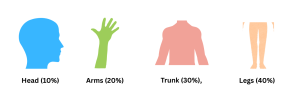
The Psoriasis Area and Severity Index (PASI) is widely used method for determining the severity of psoriasis and the response of the medical treatment. PASI score determines the amount of skin involvement, redness, thickness, and scaling by measuring four body parts. This four main body areas are head, trunk, upper and lower limbs. If the score indicates that is high it determines a more severe illness, like if PASI Score ≥10 is often seen as severe condition. In clinical practice and researches, improvements of method like a 75% decrease in PASI 75 are important indicators of medical treatment efficacy. PASI continues to be one of the most used standard method in dermatology since it offers both clinical and scientific value.
Components of PASI Score
For every of the 4 main body areas that are examined, the below components are taken into evalution.
- Redness (Erythema)
- Thickness (Induration)
- Scaling (Desquamation)
- Body Surface Area (BSA) involvement
Clinical Use of PASI Score
In clinical practice and research, the Psoriasis Area and Severity Index (PASI) is widely used to assess the severity of the illness, track treatment response, and inform treatment choices. Dermatologists are able to evaluate if advanced treatments are necessary when a patient’s score is more than 10, which often indicates severe psoriasis. Improvements like PASI 75 have been used in clinical studies to demonstrate the success rate of a treatment and are commonly required before for the approval of new medications. . Its use in both normal dermatology and deep studies highlights how crucial it is as the gold standard for evaluating psoriasis.
Limitations of PASI
The Psoriasis Area and Severity Index (PASI) comes along with some limitations that have their impact on the accuracy and usability. Because it relies on a subjective body surface area (BSA) the evaluation may lead to inter-observer variability results. Also, it lacks sensitivity for minor illness or to certain regions such as the face, nails, palms, and soles. PASI score may miss important patient emotions like itching or mental distress, and its complex nature makes it less useful for everyday clinical applications. Changes in PASI scores also don’t necessarily mean a clinical improvement or a patient’s actual quality of life.
Advantages of PASI Score
Psoriasis Area and Severity Index (PASI) is a common method used for determining the severity of psoriasis, directing medical treatment choices, and tracking patient progress. It is trustworthy method and consistent one because it gives a overall score based on the body surface area that are affected, redness, scaling and thickness. PASI score is useful for remote care and clinical practice since it is non-invasive and simple to use. Improvements in PASI scores are highly associated with improved quality of life in patients, and it is essential in clinical traits in evaluating new treatments and obtaining regulatory approval. It supports doctors in setting treatment objectives and efficiently monitoring long-term illness management.
FAQs about PASI
How is the PASI score calculated?
By evaluating redness, thickness, scaling, and body surface area affected in four body regions.
What does a high PASI score mean?
Indicates severe psoriasis with widespread or intense skin involvement.
What is PASI 75?
A 75% reduction in PASI score from baseline, showing effective treatment response.
Why is PASI important in treatment?
Helps doctors track progress, adjust therapy, and evaluate new medications.
Are there limitations to PASI?
Yes, it may not capture mild disease, nail involvement, itching, or patient experience fully.
Can PASI be used in telehealth?
Yes, it can guide remote monitoring through visual assessment by healthcare providers.
Explore More Helpful Health Tools
Our website is here to create tools that help people to make better life choices and having your body and mind in control. We provide a range of health related tools like the PASI Score Calculator designed to support your well-being.
Below you will find a couple of them and much more that are just a search away . If you don’t find any specific test or calculator you’re looking for please feel free to contact-us so we can create it for everyone.
Dermatology Life Quality Index (DLQI)
Measures the impact of skin conditions on a patient’s quality of life through a simple, self-reported questionnaire.
PAINAD – Pain Assessment in Advanced Dementia Scale
Assesses pain levels in patients with advanced dementia who cannot communicate verbally, using observable behaviors.