
PAINAD – Pain Assessment in Advanced Dementia Scale
The PAINAD (Pain Assessment in Advanced Dementia) Scale is a tool used to evaluate pain in patients with advanced dementia who cannot communicate verbally. It assesses behaviors such as breathing, facial expressions, and body language to determine pain levels. Understanding PAINAD scores helps doctors to provide appropriate pain management.
PAINAD Calculator is intended for informational and educational purposes only. It should not be used as a substitute for professional medical advice, diagnosis, or treatment. Always consult your healthcare provider.
Note: The original method evaluates pain 0 as ‘No pain’ and 10 as ‘Severe pain’.
Pain in dementia patients
Pain in dementia patients is very common due to the communication problems and can be easily missed. Patients can display behavioral or physical changes, such as restlessness, anger, agitation, or changed sleep routines. Healthcare providers should know this signals, to be able to use proven evaluation methods for pain. Also, they need to consider not to avoid medication in the first steps and when it’s necessary to use them wisely. Effective pain treatment requires constant monitoring and interaction with the care team. Detection and intervention in early stage can have a significant impact on the comfort and quality of life for the patients.
Challenges of Pain Assessment in Dementia
Cognitive decline, memory loss, and communication challenges that limit self-reporting make it challenging to assess pain in dementia patients. Some behavioral actions such as agitation or confusion can be easily confused with advancement of dementia, and vision or hearing loss can make pain scales harder to use. Healthcare providers may miss pain symptoms due to false beliefs, no training or experience, or confusing it with other conditions symptoms. Some tools that are reliable and effective such as PAINAD or PACSLAC show proper evaluation of the conditions. These difficulties indicate the need for training the healthcare staff , careful monitoring, and improving tools to make sure that pain is evaluated and managed without lowering quality of life.
What is PAINAD Scale ?
The Pain Assessment in Advanced Dementia (PAINAD) scale is an observation method developed to measure the pain in patients with dementia or that are not able to describe their pain due to cognitive problems. PAINAD scale use 5 factors related to behaviors to evaluate it. To each of the behaviors is given a score from 0 to 2, which sums up to total score that determines the pain level. This method mainly focuses on sings that are visible rather than verbal reports, and this makes it more useful especially for late-stage dementia patients. It may be used to track changes in levels of pain and analyze how well a treatment is working.
Components of the PAINAD Scale
- Breathing / Independent of vocalization
- Negative vocalization
- Facial expression
- Body language
- Consolability
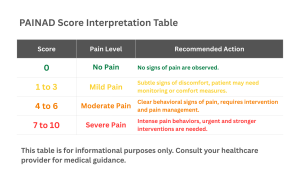
Clinical Use of the PAINAD Scale
In clinical practice, the PAINAD scale is used to measure pain in patients who are unable to self-report due to dementia or other cognitive impairments. To determine whether pain is present, clinicians look at behaviors that are listed above. PAINAD pain scale is method that assists in proving a complete pain care by helping doctors in identifying undertreated or unreported pain, directing effective actions, and enhancing patient comfort and overall care. Also, it helps track how pain changes over time, guaranteeing that treatments continue to be efficient and sensitive to the patient’s needs.
Advantages of PAINAD Scale
PAINAD Scale main advantages it the ability and capacity to determine pain properly in patients with severe dementia, and with communitative or cognitive problems. It makes use of obvious actions, from the 5 factors of the method, by providing simple, useful and reliable technique for regular clinical use. It helps doctors to track pain and provide the right treatments by providing an organized method to detect pain, which lessens unrecognized suffering and improves complete pain management.
Limitations of PAINAD Scale
PAINAD pain Scale comes along with some limitations. Not being a very specific tool it may cause overestimation of pain and maybe needless treatments. Relying too much on observable behaviors might be subjective, and certain things, like breathing, could not represent pain but may reflect other medical conditions. Also, PAINAD scale may not be efficient in all cases and might miss types of pains in different patients groups, like those in general hospitals. The scale could not precisely measure higher levels of pain. Factors like small sample sizes, single-center studies makes it harder to apply the results to everyone.
Discover More of What We Offer
Our website is focused on providing tools that inspire people to make healthier choices and take charge of their body and mind. We feature a range of health calculators, such as the PAINAD Calculator, all designed to support your overall wellness.
Below, you’ll find two examples of these tools, with many more available through a quick search. If you don’t see the test or calculator you’re looking for, simply reach out. We will be happy to create it for you and others who may benefit.
Critical Care Pain Observation Tool (CPOT)
An observational scale used in ICU settings to assess pain in patients who are unable to self-report.
FeverPAIN Score for Strep Pharyngitis
A clinical scoring system that helps estimate the likelihood of streptococcal throat infection and guides decisions on antibiotic use.