
Modified Early Warning Score (MEWS Score) for Clinical Deterioration
The Modified Early Warning Score (MEWS) is a clinical tool used to identify patients at risk of deterioration in hospitals. It evaluates vital signs such as heart rate, blood pressure, respiratory rate, and temperature to generate a risk score. Early recognition using MEWS helps guide timely interventions and improve patient outcomes.
MEWS Score calculator is intended for informational and educational purposes only. It should not be used as a substitute for professional medical advice, diagnosis, or treatment. Always consult your healthcare provider.
What is Clinical Deterioration?
Clinical deterioration is know as a state where a patients health start to worsen and is indicated by mental state changes and abnormal vital signs. The abnormal sings may include problems with heart rate, oxygen, breathing blood pressure, etc. It can be detected by making regular check-ups, understanding the anomalies and timely communication. Since early detection increases patient safety and prevents major complications or death, prompt escalation of treatment is crucial. This conditions can happen unexpectedly or it starts gradually, so continuous monitoring is very crucial. The patient will receive the proper treatment at the right moment if healthcare providers have a good team work together.
Why Early Detection of Clinical Deterioration matters?
Early detection of clinical deterioration is crucial since it minimized the risk of complicated life-threatening conditions and lowers the need of intensive care unit (ICU) hospitalizations. By identifying minor warning sings, it gives the opportunity for immediate interventions that results in improved patients outcome, safety and proper medical treatment. Also, it is cost-effective, supports high quality treatment, hospital stays are reduced by using Rapid Response Teams systems. Healthcare staff also plays a crucial role due to the fact the they are the first that notice the early changes and continuous monitoring, which makes them both reliable and effective.
What is Modified Early Warning Score (MEWS)?
The Modified Early Warning Score (MEWS) is a clinical tool used to detect early signs of patient deterioration by scoring vital signs such as heart rate, blood pressure, respiratory rate, temperature, and mental status. The sum of the score determines the patient’s risk level and helps with guiding the right medical response and appropriate monitoring. High MEWS score indicates a greater instability and a activation of Rapid Response Teams. MEWS score have an impact on improving communication between healthcare teams, lowers the undesired outcomes and promotes early detection. It also helps prioritize care for patients who need immediate attention. Below you will have the parameters and an MEWS Score chart (table).
Parameters of MEWS Score
- Heart rate
- Systolic blood pressure
- Respiratory rate
- Temperature
- AVPU scale (Alert, Verbal, Pain, Unresponsive)
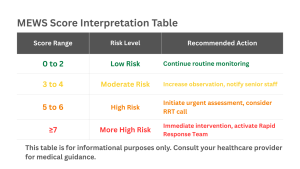
Clinical Application MEWS Score
Patients at risk of clinical deterioration are identified using the Modified Early Warning Score (MEWS), which evaluates vital signs and consciousness. MEWS Scoring helps doctors to react in proper way, directing the monitoring process, increasing the level of care or Rapid Response Team activation. It improves the early recognition of patient decline, increased outcomes by lowering ICU stays and cardiac arrests. Also, it provides a useful consistent method for making the right clinical decisions. Integration with other care systems, awareness of the situation, and training are necessary for efficient usage.
Advantages of MEWS Scoring
By identifying early warning signs of patient decline, the Modified Early Warning Score (MEWS) enables immediate treatments that increase patient outcomes, decrease ICU stays, and lower death rate. It is affordable, user-friendly, and suitable for a range of healthcare environments. MEW score enables fast response systems, standardizes communication between medical teams, and improves the clinical outcome while lowering problems and expenses. It provides healthcare providers with a clear, objective method to help them make the right medical decisions.
Limitations of MEW Score
Beside having good advantages the Modified Early Warning Score (MEWS) comes along with some limitations. Because MEW Score is a screening tool rather than a diagnostic one, it may incorrectly identify patients, resulting in false positives or negatives. Medical judgment is essential since the method used is standardized and could not take into account patients specific characteristics or other clinical problems. The accuracy of MEWS Scoring can be lowered in some populations groups, it relies on intermittent manual measurements, and recording or interpretation mistakes may reduce also the accuracy. MEWS Score should be used with other medical information due to the fact the it may ignore important indicators of decline if used alone.
Discover More of What We Offer
Our website is focused on providing tools that inspire people to make healthier choices and take charge of their body and mind. We feature a range of health calculators, such as the MEWS Score Calculator, all designed to support your overall wellness.
Below, you’ll find two examples of these tools, with many more available through a quick search. If you don’t see the test or calculator you’re looking for, simply reach out. We will be happy to create it for you and others who may benefit.
FeverPAIN Score for Strep Pharyngitis
Clinical scoring system to assess the likelihood of streptococcal throat infection and guide antibiotic prescribing.
Light’s Criteria for Exudative Effusions
Diagnostic criteria used to differentiate exudative from transudative pleural effusions based on protein and LDH levels.