
FeverPAIN Score for Strep Pharyngitis
The FeverPAIN Score is a clinical tool used to assess the likelihood of streptococcal pharyngitis (strep throat) in patients with sore throat symptoms. It helps guide the need for antibiotic treatment by evaluating simple clinical features such as fever, tonsillar inflammation, and absence of cough.
FeverPAIN Score Calculator is intended for informational and educational purposes only. It should not be used as a substitute for professional medical advice, diagnosis, or treatment. Always consult your healthcare provider.
What Is Strep Pharyngitis?
Strep pharyngitis, also known as strep throat, is an throat illness that is created by Group A Streptococcus bacteria. Usually, it appears as fever, swollen tonsils, painful neck glands, and unexpected sore throat. Mostly sore throats are caused by viruses and bacteria, but strep throat requires medical evaluation and may need medical treatment to manage symptoms. The medical treatment that can be used have their impact in avoiding and lowering the rheumatic fever and lower trancmission. Patients who are most likely to have a bacterial infection and benefit from antibiotics can be evaluated with the FeverPAIN Score.
Challenges in Diagnosis Strep Pharyngitis
Medical examination is sometimes unreliable for diagnosing strep pharyngitis since its symptoms are similar to those of viral sore throats. Some test like the rapid antigen tests (RADTs) can provide faster results but may miss infections, while throat cultures are slower and need more resources but it is more accurate. Because a positive test does not always indicate a current infection, asymptomatic carriers make interpretation much more difficult. Since no method is ideal, clinical scoring systems such as FeverPAIN help in directing tests and minimizing the use of useless antibiotics.
Why a Correct Diagnosis Is Important for Strep Throat?
Making the correct diagnosing for strep throat is essential because it avoids major side effects like rheumatic fever, renal inflammation, or throat abscesses, strep pharyngitis. Also, it lowers antibiotic resistance by preventing unnecessary use of antibiotics for viral illnesses. A precise diagnosis improves a quicker recovery, prevents the spread of illness, and ensures that patients receive the appropriate care and instruction. It also builds patient trust by showing that treatment decisions are based on clear evidence rather than intuition.
What is the FeverPAIN Score?
The Fever PAIN Score is an evaluation tool used to advise the proper use of antibiotics and evaluate the risk of streptococcal pharyngitis, a bacterial sore throat. This medical tool evaluates 5 criteria and each of them is assigned 1 point if they are present. In the evaluation process if the score is high it indicates a greater chance of bacterial infection and a stronger need for antibiotics, while with a lower score indicating a viral cause. Comparing the fever Pain score with rapid strep test, the tool is more affordable, helps in avoiding unnecessary use of antibiotics, and increases patients outcomes. Also, it helps healthcare providers in making more accurate and fast decision based on evidence in busy hospitals.
FeverPAIN Score Components
- Fever during previous 24 hours.
- Purulence (pus on tonsils).
- Attendance in the clinic (within 3 days of symptom).
- Inflamed tonsils (severe inflammation).
- No cough or coryza (runny nose)
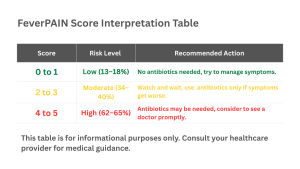
Advantages of FeverPAIN score
The Fever PAIN score helps healthcare providers by directing fast and effective treatment, assists in reducing the unnecessary use of antibiotics, being more accurate in determining the bacterial illness and improving the patients outcome. Being a affordable tool, Fever PAIN score gives a better report of the illness level, it allows shared decision-making with patients, supports antimicrobial stewardship, and is reasonably priced. It lowers the risk of resistance by identifying individuals with viral infections. It increases the effectiveness of care by helping healthcare providers to provide focus to patients who are most likely to benefit from medical treatment. It also provides a simple and user-friendly tool that may be used in standard clinical settings without requiring extensive testing.
Limitations of FeverPAIN score
Fever PAIN score may be very useful tool but it also has some limitation. Low positive predictive value, which might result in incorrect diagnoses and needless antibiotic treatment, and low sensitivity, which could cause it to overlook bacterial infections are some of the Fever PAIN limitations. Also, the ability to detect patients at risk for severe problems, such as peritonsillar abscesses. Different ways doctors use the FeverPAIN score and biases in studies make it less reliable. Doctors should use FeverPAIN together with their judgment and other tests, not on its own.
More Tools to Support Your Health
Our website is here to create tools that help people to make better life choices and having your body and mind in control. We provide a range of health related tools like the Fever PAIN Score Calculator designed to support your well-being.
Below you will find a couple of them and much more that are just a search away . If you don’t find any specific test or calculator you’re looking for please feel free to contact-us so we can create it for everyone.
Centor Score Calculator
A tool to quickly estimate the likelihood of strep throat and guide appropriate treatment.
ARISCAT Score Calculator
A clinical tool to assess the risk of postoperative pulmonary complications in surgical patients.