
Light’s Criteria for Exudative Effusions
Light’s Criteria for Exudative Effusions is used to determine whether a pleural effusion is exudative or transudative, helping identify the underlying cause of fluid accumulation in the pleural space. This diagnostic tool compares protein and lactate dehydrogenase (LDH) levels in pleural fluid and serum to guide further clinical evaluation.
Light’s Criteria Calculator is intended for informational and educational purposes only. It should not be used as a substitute for professional medical advice, diagnosis, or treatment. Always consult your healthcare provider.
What is Pleural Effusion?
Pleural effusion occurs when fluid builds up in an unusual way in the pleural space, which is the narrow area between the lungs and the chest wall. Only a tiny amount of fluid is typically present to help with breathing. Excess fluid can build up because of overproduction or poor drainage, which compresses the lungs and results in symptoms including coughing, chest discomfort, and shortness of breath. Infections, heart failure, liver illness, cancer, and autoimmune disorders are the most common causes. Doctors usually diagnose it with scans like X-rays or CT, and sometimes by taking out a sample of the fluid (thoracentesis). Treatment focuses on fixing the cause and may also involve draining the fluid.
Why is Pleural Effusion Classification Important?
Pleural effusion can be classified as either transudate or exudate, and this difference is very important because it guides how doctors diagnose and treat the condition. Transudates typically arises from general issues like heart failure and require less testing, but exudates have been associated with local diseases like infections, cancer, or inflammation and requires further testing.
This classification assists healthcare providers to select the best possible medical treatment, in evaluating the seriousness of the illness his classification and in making the best management plans for their patients. Doctors can react more quickly and prevent unnecessary operations if they are aware of the nature of effusion. Patients outcomee it can be improved more by making sure that the correct treatment will be given at the right moment.
Traditional vs Modern Approaches in Pleural Effusion
Traditional treatment involved invasive open biopsies, pleurodesis, and chest tube drainage, which often resulted in uncomfortable and extended hospital stays. On the other hand, modern methods point to less invasive and outpatient methods. Medical thoracoscopy, image-guided biopsies, and advanced imaging (CT, PET-CT) have improved the safety and accuracy of diagnosis. Hospitalizations are decreased with Indwelling Pleural Catheters (IPCs), which offer long-term symptom management at home. The main change is moving toward medical care that is less invasive, focused more in patients comfort, especially for cases with malignant pleural effusion.
What Is Light’s Criteria?
Light’s Criteria is a medical method that is used to identify the nature of pleural effusion, that are excess fluid surrounding the lungs. It assists healthcare providers in determining if the fluid is transudative or exudative. These method measures the amounts of lactate dehydrogenase (LDH) and protein in the blood and pleural fluid. The fluid is defined as exudative if specific criteria are reached. In order to ensure that the underlying cause of the fluid buildup is effectively treated, this information helps doctors make decisions about the next steps for diagnosiss and medical treatment.
The Three Key Components of Light’s Criteria
In this part it will be explained how lights criteria evaluates if it is exudate or transudate. The pleural effusion is determined as exudate when at least one of these three conditions is met. Often, when the condition is evaluated to exudate it indicates more severe cause such as infection, inflammation, or cancer. If none of the lights criteria components isn’t met the effusion is considered as a transudate. This can occur as a result of systemic pressure changes brought on by diseases like liver disease or heart failure. Below you will have listed the 3 criteria that the light criteria is based.
The Three Criteria:
- Pleural fluid-to-serum protein ratio > 0.5: Compares protein levels in pleural fluid and blood.
- Pleural fluid-to-serum LDH ratio > 0.6: Compares lactate dehydrogenase (LDH) in pleural fluid and serum.
- Pleural fluid LDH > 2/3 the upper limit of normal serum LDH: Compares absolute LDH in pleural fluid to the normal serum maximum.
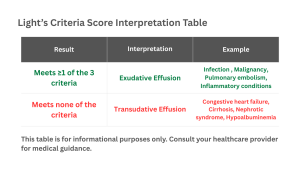
Clinical use of Light’s Criteria
Light criteria help healthcare providers in determining if fluid over the lungs is caused by a larger body issue such as liver or heart problems or a local issue like infection or cancer. Below you have the main purpose why the light criteria is used.
- Determine the Cause: Determine if the fluid is a transudate or an exudate.
- Guiding Tests and Treatment: Help decide if further tests or treatments are needed.
- Check Fluid: Evaluate the amount of protein and LDH in the chest fluid.
Advantages of Light’s Criteria
Light criteria is a reliable method for evaluating the type pleural effusions. It is considered as the gold standard for pleural fluids analysis because of the great sensitivity, which oftens allows them to detect exudative effusions with an accuracy of over 98%. They help in directing additional testing and treatment options when nedded by identifying the type of effusions and improving patient care.
Research shows that it is more reliable than depending only on a doctor’s first evaluation. Lights criteria offer an organized biochemical method, and also simpleir version can be found for a more useful application in healthcare. They also help in avoid extra tests and procedures by pointing to the most likely cause of the fluid, allowing for faster and better patient care.
Limitations of Light’s Criteria
Light’s Criteria is very sensitive tool for detecting exudative pleural effusions but have some limitations. They can sometimes mistakenly identify transudates as exudates, in particular to patients with heart problems and those using diuretics, and also may incorrectly categorize certain malignant effusions as transudates.
The criteria turn continuous lab values into strict cut-off points, which may lead to incorrect identification of cases that are close to the limit.Doctors use Lights Criteria in combination with the serum-to-pleural albumin gradient, clinical judgment, and other diagnostic instruments including imaging and biomarkers to increase accuracy. Light Criteria is still helpful, but it shouldn’t be used as the only tool for diagnosis because of these limitations.
More Tools to Support Your Health
Our website is here to create tools that help people to make better life choices and having your body and mind in control. We provide a range of health related tools like the Light’s Criteria Calculator designed to support your well-being.
Below you will find a couple of them and much more that are just a search away . If you don’t find any specific test or calculator you’re looking for please feel free to contact-us so we can create it for everyone.
LRINEC Score for Necrotizing Soft Tissue Infection
A tool that uses routine lab values to help identify and assess the risk of life-threatening necrotizing soft tissue infections.
Critical Care Pain Observation Tool (CPOT)
A pain assessment tool for non-verbal or critically ill patients, using behavioral and physiological indicators to evaluate pain levels.