
Centor Score Calculator – Instantly Check Strep Throat Risk
The Centor Score Calculator is a clinical tool used to estimate the likelihood of streptococcal pharyngitis (strep throat). It helps healthcare providers decide whether testing or antibiotic treatment is necessary. Accurate scoring with the Centor Calculator supports timely diagnosis and appropriate patient care.
Disclaimer
Centor Score Calculator is intended for informational and educational purposes only. It should not be used as a substitute for professional medical advice, diagnosis, or treatment. Always consult your healthcare provider.
What Is Strep Pharyngitis?
Group A Streptococcus, also known as group A strep, is a kind of microbe that causes infections in the tonsils and throat. An irritating throat and extreme inflammation are symptoms of strep throat. The illness may usually be diagnosed by a medical professional using a throat culture or a quick strep test. Antibiotics are typically used in treatment.
When an infected person coughs or sneezes, the virus can spread through droplets, as well as through shared food and beverages. Microbes can be transferred to your mouth, nose, or eyes by coming into contact with them. Children between the ages of 5 and 15 are more likely to get strep throat. However, also it can have the same impact on other people of different group ages who are more likely to interact directly with kids.
A painful throat is one of the early signs of step-throat. Also, fever can be taken very fast and reach its peak on the second day of the illness. Coughing is one symptom that strep throat usually doesn’t cause. You probably have a viral infection rather than strep throat if you have a cough along with other cold symptoms.
Symptoms of strep throat:
- Fever
- Headache
- Swelling and red tonsils
- Painful swallowing
- Vomiting or nausea, particularly in younger children
- Throat pain
- Pus streaks or white areas on the tonsils
- Sore throat that may seem red and worsen very soon
What is the Centor Score?
To help doctors identify GAS pharyngitis from more typical viral causes and to give later testing and treatment options the Centor Score for strep pharyngitis was created. Doctors use it to make decisions about additional testing and therapy. When adult patients complain of sore throats, a set of criteria known as the Centor Criteria can be used to determine the possibility of a bacterial infection. The purpose of their development was to provide a rapid diagnosis of either streptococcal pharyngitis or the presence of a Group A streptococcal infection.
Centor Criteria for Strep Throat
The Centor Score comes in use when a patient complains of a sore throat so the factors and facts of the score are collected to identify the risk for bacterial infection. For each one of the components, the patient gets 1 point which is given below. Based on these components the score is calculated from 0 to 4 points. Score is interpreted in 3 risk stages low (0-1), moderate (2-3), and high (4).
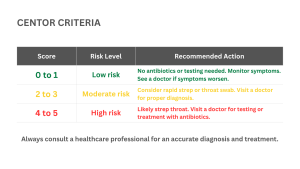
Components of Centor Score
- Age
- Swelling or exudates on tonsils
- Tender and/or swollen anterior cervical lymph nodes
- Temperature (> 38 °C or 100.4 ° F)
- Cough present
If the score indicates that you might have something and your infection starts to be painful do not try to treat it at home even if it is easily treatable. It is important to get the right diagnosis and treatment so the doctor can give you the proper way to treat the infection you might have.
Clinical Use of Centor Score
Centor criteria is mainly used to assists in deciding if the patients is having symptoms of sore throat should do additional testing for Group A Streptococcus. When the score is evaluated as low score it indicates a low probability of strep throat, and usually medications are not required. On the other hand, when the score is evaluated a high one it indicates a greater chance if streptococcal infection , which further testing like a confirmation from a throat culuture or rapid antigen detection test (RADT). The outcome of the test are used to make the right medical treatment choices, also when it is positive one of the medications type are antibiotics to prevent further rheumatic fever problems. Centor score is usually used to have an improved and precise diagnostic, especially for older and pediatric populations.
Advantages of Centor Criteria
When analyzing sore throat symptoms and determining the probability of Group A Streptococca pharyngitis, the Centor Score strep provides a useful and accurate method. It helps healthcare providers in making evidence based choices when to give antibiotics and when tests are nedded for strep throat, which lowers the risk of antibiotic resistance and prevents needless antibiotic use. The centor criteria increases the accuracy for diagnosing, improves the effectiveness of medical resources use, and in the decision-making it improves for patients with sore throat symptoms by classifying patients based on their risk level.
Limitations of Centor Criteria
Despite being a useful tool for determining the risk of strep throat, the Centor Score come along with some limitatins. To have an accurate evaluation throat cultures and quick antigen detection are still necessary, due to this centor score should not be used as the only method of evaluation.
The medical environment, symptom reporting, and patient age can all affect its predictive value.
It might be difficult to evaluate important parameters like tonsillar exudate or lymph node tenderness in telemedicine or self-assessment scenarios. Centor criteria works better as a helpful reference along with medical judgment, rather than independent diagnostic method.
Explore More Helpful Health Tools
Our purpose is to create tools that help people make smarter decisions about their health and take charge of their physical and mental wellness. Tools like the Centor Score Calculator is one tool from the range we provide to support your well-being.
Below, you’ll find a few of these tools—and many more are just a quick search away. If there’s a specific test or calculator you’re looking for and don’t see it, feel free to reach out. We’re always happy to create new tools that can benefit you and others.
Child Pugh Score Calculator – Instantly Calculate Cirrhosis Severity
Use the Child-Pugh Score Calculator to assess the severity and prognosis of chronic liver disease, especially cirrhosis.
General Anxiety Disorder-7 (GAD-7) Calculator
Use the GAD-7 Calculator to quickly screen for generalized anxiety and assess its severity based on your symptoms over the past two weeks.