
Bishop Score Calculator Effective for Vaginal Delivery and Induction of Labor
The Bishop Score Calculator is used to assess cervical readiness for labor and predict the likelihood of successful vaginal delivery or induction. It evaluates factors such as dilation, effacement, and fetal position. Accurate calculation helps clinicians make informed decisions and optimize labor management.
Bishop Score Calculator is intended for informational and educational purposes only. It should not be used as a substitute for professional medical advice, diagnosis, or treatment. Always consult your healthcare provider.
What is Vaginal Delivery?
The natural method that everyone is born at the end of a woman pregnancy through the birth canal, or vagina is known as vaginal delivery. It typically involves coordinated uterine contractions and the mother’s pushing efforts. Also, it is the most popular and preferred method of vaginal delivery. The main reasons are because of the fact that is usually low-risk and offers the most advantages for both the mother and the baby.
Vaginal Delivery Types:
- Spontaneous Vaginal Delivery : Occurs when labor begins and develops on its own without assistance.
- Induced Vaginal Delivery : Medications or other methods are used to start labor.
- Assisted Vaginal Delivery : A vacuum or forceps are used to help give birth.
Benefits of Vaginal Delivery:
- The woman recovers more quickly and spends less time in the hospital.
- Fluid that naturally leaves the baby’s lungs.
- Could strengthen the infant’s immune system.
- Less chance of some respiratory problems in babies than after a caesarean section.
What is Labor Induction?
The technique used for the process of artificially initiating labor when it hasn’t naturally started is known as labor induction. For the purpose of achieving a vaginal birth , are used medicinal and mechanical techniques to cause uterine contractions and cervical ripening. Induction can raise the chances of a cesarean birth, higher contractions, and other difficulties for the unborn child, even that is mostly required and beneficial.
Why Induction is Done
- Post-term pregnancy (beyond 41–42 weeks
- Maternal health conditions, such as diabetes, high blood pressure, and preeclampsia
- Fetal concerns (low amniotic fluid, placental problems, poor development)
- Infection of the uterus
- Elective induction (without a medical justification, after 39 weeks)
Why Predict the Success of Induction?
It’s very critical to understand the probability that a vaginal delivery is possible after the labor induction for a number of reasons. It helps healthcare providers to have better guidance for the patients, enables for both of them to have better decisions making together and guarantees the proper way to use medical resources. Knowing the probability of a successful vaginal delivery can help prevent unnecessary procedures and enhance the mother’s and the baby’s health and safety.
What is the Bishop Score?
Bishop score is a test used for predicting whether or not labor induction will be successful. Dilation, effacement, position, consistency, and the fetal head’s station in the pelvis are the medical guidelines for the scoring system evaluation. To determine when cervical ripening is necessary, the Bishop score is commonly used during digital cervical checks at the time of induction. This method has been recognized for its ease to use and reliability in predicting vaginal delivery, which assists in reducing the risk of emergency cesarean birth, which has a high rate of morbidity and death for both the mother and the fetus.
Why is it Important?
Importance of Bishop Score relays in the help of predicting the success of labor induction and evaluating the cervix’s condition. If the score is high it indicates a more appropriate cervix for vaginal birth. The score is based on cervical dilatation, effacement, consistency, position, and fetal station. Healthcare providers can use this score to choose which cervical ripening technique to use and if to move on with induction.
Benefits of Bishop Score
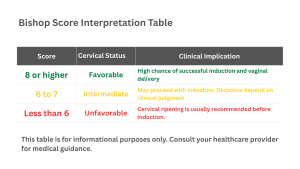
- Predicts the success of induction: A score of eight or above indicates a higher likelihood of natural labor progression following induction.
- Guides cervical ripening: A low score (less than 6) indicates that the cervix is not yet ready, requiring the use of ripening techniques.
- Improves decision-making: Assists medical professionals in selecting the most effective induction technique and best time.
- Consistency: Offers a consistent method for evaluating cervical condition in various patients.
- May reduce C-sections: Identifying good candidates for induction helps avoid unnecessary cesareans.
Components of the Bishop Score
-
- Cervical dilation (in cm).
- Cervical effacement (in percentage).
- Cervical consistency (firm, medium, soft).
- Cervical position (posterior, mid-position, anterior).
- Station of the fetal head relative to the ischial spines.
Bishop Scoring System
Limitations of the Bishop Score?
Bishop score is a helpful method for evaluating for determining cervical condition just before the labor induction, but it has some disadvantages. It uses a manual examination, which might be subjective and change across medical professionals. The precision of the score may be impacted since it only checks the vaginal area of the cervix and ignores the cervical length.
Women’s with a lower score still give birth vaginally, so even though a higher score indicates a better probability of having an effective induction, it’s not always accurate. In some medical conditions like as placenta previa, the score may be dangerous to use. Also, it only offers a single image and ignores changes that may occur all over labor. That’s why doctors sometimes use other tools, like ultrasound or special tests like fetal fibronectin, to get a clearer picture instead of relying only on the Bishop Score.
Explore More Helpful Health Tools
Our website is here to create tools that help people to make better life choices and having your body and mind in control. We provide a range of health related tools like the Bishop Score Calculator for Vaginal Delivery and Induction of Labor designed to support your well-being.
Below you will find a couple of them and much more that are just a search away . If you don’t find any specific test or calculator you’re looking for please feel free to contact-us so we can create it for everyone.
Serum Anion Gap Calculator – Instantly Detect Acid-Base Imbalances
Quickly assess acid-base imbalances by calculating the serum anion gap.
General Anxiety Disorder-7 (GAD-7) Calculator
Screen for and measure the severity of generalized anxiety disorder symptoms.