
ARISCAT Score Calculator – For Postoperative Pulmonary Complications Risk
The ARISCAT Score Calculator is used to predict the risk of postoperative pulmonary complications in patients undergoing surgery. It helps clinicians identify high-risk patients and implement preventive strategies. Using the ARISCAT Score supports safer surgical planning and improves patient outcomes.
Disclaimer
This calculator is intended for informational and educational purposes only. It should not be used as a substitute for professional medical advice, diagnosis, or treatment. Always consult your healthcare provider.
What are Postoperative Pulmonary Complications (PPCs)?
Postoperative pulmonary complications (PPCs) are frequent and serious, and patients’ mortality is increased by them. Pulmonary problems are common after surgery. These problems may include respiratory failure, vascular thrombosis, pneumonia, and pain-related atelectasis. Thrombosis is not the only approach used to predict the possibility of postoperative respiratory problems.
PPCs have multiple causes, including the acute side effects of surgery the anesthesia that comes along with it, and also the patient’s long-term health. Lung functions can be affected negatively by the surgery itself, and these effects continue into the postoperative phase to a lesser degree, after the procedure. Age, habit, lifestyle, and poor cardiorespiratory health are well-established chronic risk factors for PPC.
When you take into account factors like age, the importance of the procedure, blood oxygen and hemoglobin levels, and the history of respiratory infections within the previous month the ARISCAT score determines the possibility of pulmonary problems. These facts determine whether the danger is considered low, moderate, or severe.
What is the ARISCAT Score?
A clinical technique used by healthcare providers to predict the probability of postoperative pulmonary complications (PPCs) in patients having serious abdominal surgery is the Assess Respiratory Risk in Surgical Patients in Catalonia (ARISCAT score).
The risk index, which is based on seven simple-to-measure objective elements, has a significant amount of predictive power. The index can be used to determine a person’s personal risk of PPC and direct focus on future research into better patient treatment. The score is categorized into 3 stages that are low, moderate and high from the evaluation. By predicting health problems like pneumonia or respiratory failure, the score helps the healthcare providers to have personalize perioperative therapy with improved patient outcomes.
Components of the ARISCAT Score
- Age.
- Preoperative oxygen saturation.
- Respiratory infection in the last month.
- Preoperative anemia
- Surgical incision
- Duration of surgery
- Emergency procedure
ARISCAT Score Interpretation
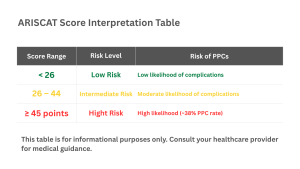
Advantages of ARISCAT Score
This score is an easy-to-use tool and proven technique for prediction of PPCs in surgical patients. It’s a reliable tool for detecting high-risk patients because of its strong predictive accuracy. Using standard preoperative characteristics, it is simple to use, and its efficacy has been shown in a variety of surgical populations. By detecting the early risks, this score increases the patients outcome, reduces the staying in hospital and helps provide better, efficient and cost-effective perioperative care.
Limitations of ARISCAT
The ARISCAT score helps predict lung problems after surgery but has some limits. It doesn’t work well for chest (thoracic) surgeries because these affect the lungs differently. In some cases due to the limits to specify and positive predictive values, the score sometimes classifies incorrectly patients with higher danger and can underestimate danger especially in cases in higher levels. It also doesn’t include all health factors that affect lung problems after surgery. Using it along with other tests or lab results might make it more accurate.
Explore More Helpful Health Tools
Our website is dedicated to creating tools that empower people to make informed life choices and take control of their physical and mental well-being. We offer a variety of health-related tools, such as the ARISCAT Calculator for Postoperative Pulmonary Complications, all designed to support your overall wellness.
Below, you’ll find some of our featured tools, along with many more just a quick search away. If you don’t see a specific test or calculator you need, feel free to contact us, and we’ll be happy to create it for the benefit of everyone.
FENa Calculator – Instantly Check Fractional Excretion of Sodium
Instantly calculate the fractional excretion of sodium to help evaluate acute kidney injury.
Serum Anion Gap Calculator – Instantly Detect Acid-Base Imbalances
Quickly assess acid-base imbalances using electrolyte values.