ABCD2 Score Calculator Effective for TIA
The ABCD2 Score Calculator is used to assess the risk of stroke following a transient ischemic attack (TIA). It evaluates factors such as age, blood pressure, clinical features, duration of symptoms, and diabetes. Accurate scoring helps clinicians identify high-risk patients and guide timely preventive interventions.
Disclaimer
ABSD2 Calculator is intended for informational and educational purposes only. It should not be used as a substitute for professional medical advice, diagnosis, or treatment. Always consult your healthcare provider.
What is Transient ischemic attack (TIA) ?
Transient ischemic attack (TIA) is considered like a mini-stroke and this means that a part of your brain for a temporary interruption has a lack of blood flow. If the blood flow is missing the brain cells develop a fault and they start to die. Tia (Transient ischemic attack) is a medical emergency that is very close to ischemic stroke. The symptoms of TIA and ischemic stroke are very alike but TIA symptoms last for 24 hours and most of them go away in just minutes. Below you have some of the symptoms of Tia listed.
Symptoms of a TIA
- Partial paralysis or weakness
- Speaking difficulties or loss of speaking
- Lack of control over muscles of facial droop
- Vomiting and nausea.
- Memory loss
- Headaches
Why Early Stroke Risk Evaluation Matters
Early stroke risk evaluation is crucial, since it allows for fast diagnosis and treatment that can lower brain damaged and reducing the high chances of dying. Detecting risk factors such as high blood pressure, atrial fibrillation, and lifestyle choices give the opportunity to implement successful strategies to prevent them. By avoiding large strokes and the need for extended rehabilitation, early intervention improves outcomes, improves quality of life, and lowers healthcare costs.
What is the ABCD2 Score?
ABCD2 score is essential clinical tool that helps healthcare providers to evaluate patient risk of stroke for the next 2 days (or 48 hours) after transient ischemic attack. This tool assist the doctor to determine the patient priorities for further evaluation and treatment. The score is based on 5 parameters, which of them have a scoring range and each score is evaluated into 3 stages that will be shown below.
ABCD2 Score Components
- Age
- Blood pressure
- Clinical features,
- Duration of symptoms (TIA)
- Presence of diabetes
Score Interpretation and Risk Stratification
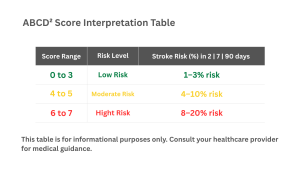
ABCD2 score parameters each one of them is added together to get a score that ranges from 0 to 7. Interpretation of the score is estimated in three stages low, moderate, and high below will be an table with each stage and point.
Advantages of the ABCD2 Score
When doctors are evaluating the stroke risk after a transient ischemic attack (TIA), ABCD2 Score offer a variety of benefits. To prioritize urgent healthcare this tools helps doctors to efficiently classifying patients into low, moderate, and high-risk groups. It is useful in and specialized care settings because to its simplicity of usage Being a simple score to calculate and evaluate with simple clinical data the score predicts stroke risks in the first week after TIA which helps both patients and healthcare providers.
Apart from being widely used in clinical practice, it has some use in estimating the risk of stroke in the long term, enabling rapid and efficient patient care. The ABCD 2 score improves the condition of patients and lowers the risk of further strokes by guiding immediate treatment options.
Limitations of the ABCD 2 Score
Despite being commonly used to evaluate stroke risk after a TIA, the ABCD score has a some of limitations. It might not be able to effectively differentiate between people at low and high risk, particularly those who need immediate care for problems like atrial fibrillation or carotid stenosis. Some factors like stroke severity, long-term effects some important neuroimaging findings like infarction are not taken into consideration by the tool.
Also, in some cases it may not take into consideration the risk of stroke, and in some patients with low scores, it may result in false claim. Healthcare providers and other specialist evaluation are still crucial , beside researching and looking for other ways to improve it by including imaging and other risk factors.
Explore More Helpful Health Tools
Our website is dedicated to creating tools that empower people to make informed life choices and take control of their physical and mental well-being. We offer a variety of health-related tools, such as the ABCD2 Score for TIA Calculator, all designed to support your overall wellness.
Below, you’ll find some of our featured tools, along with many more just a quick search away. If you don’t see a specific test or calculator you need, feel free to contact us, and we’ll be happy to create it for the benefit of everyone.
NIH Stroke Scale Calculator
Quickly assess stroke severity using the NIHSS scoring system to support clinical decision-making.
ARISCAT Score Calculator
Estimate the risk of postoperative pulmonary complications using the validated ARISCAT scoring tool.
REFERENCE
Cleveland Clinic – Transient Ischemic Attack (TIA) or Mini-Stroke
PubMed – Validation and refinement of scores predicting stroke risk after TIA
NCBI Bookshelf – Transient Ischemic Attack