
CURB-65 Score Calculator (Effective for Pneumonia Severity)
The CURB-65 Score Calculator is a clinical tool used to assess the severity of pneumonia and guide treatment decisions. It evaluates factors such as confusion, blood urea, respiratory rate, blood pressure, and age. Accurate CURB-65 scoring helps clinicians identify high-risk patients and determine the need for hospitalization or intensive care.
This calculator is intended for informational and educational purposes only. It should not be used as a substitute for professional medical advice, diagnosis, or treatment. Always consult your healthcare provider.
What is Pneumonia ?
Inflammation in one or both lungs that fills them with fluid or pus is a symptom of the condition known as pneumonia. Some of the main causes is by viruses, bacteria or fungi which can cause breathing problems, a fever, chills, and a cough that produces pus. Symptoms can range from mild discomfort to life threatening ones. The most common symptoms will be listed below so everyone can be more informed.
Different patients group especially elderly people, child’s and those with very week immunity are more disposed to pneumonia because it can progress very rapidly. These type of patients category may need to have more urgent medical care. If you are diagnosed early is very essential because you get the right treatment and be recovered on time.
Pneumonia symptoms and signs might include:
- Your chest hurts when you breathe or cough.
- Lack of ability to think clearly or alterations in mental awareness (in individuals 65 and older)
- Coughing, which might result in phlegm
- Fatigue
- High temperature, sweating, and chills
- Body temperature that is below average
- Diarrhea, vomiting, or nauseous
- Breathing difficulty
Why Assessing Pneumonia Severity is Important
To be able to find the severity of the pneumonia is very essential because it helps healthcare providers to make better evaluation of the seriousness of the illness and give the right treatment. Is essential to know because patients can be healed at home, may need to be hospitalized or if the ICU is required to support them. Knowing the state of the patients helps in giving the right guidance what antibiotics to use in risky states and avoiding them in lower risk cases. Detecting the patients that are at risk and have serious complications, can improve patients outcome and have better usage of healthcare resources.
What is CURB-65?
One way to find out if you might have pneumonia is the CURB-65 Score, which is frequently used to identify patients who can be safely treated and helps estimate the risk of death from community-acquired pneumonia. This score is very crucial for healthcare providers because helps them to predict the severity of pneumonia and to do the treatments in the right way. It has been proven to be effective in predicting infection and death in community-acquired pneumonia.
What Does CURB-65 Stand For?
The CURB-65 Score has 5 components or risk factors that are checked before the evaluation. Each one of the components is equal to 1 point, the total score is used to determine the right way of treatment, also if the patients need to be hospitalized or not. Below is the breakdown of the components.
- Confusion: The patients shows signs of mental confusion or is disoriented
- Urea: A high level of urea in the blood, usually 7 mmol/L or more
- Respiratory: Breathing rate is 30 breaths per minute or greater
- Blood pressure: The top (systolic) number is below 90 mmHg or the bottom (diastolic) number is below 60 mmHg.
- Age: the patient is 65 years old or older.
How the CURB Score is Used
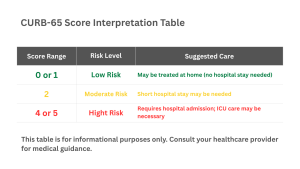
Why CURB-65 Score is Important
CURB 65 score is an fast and reliable tools for determining the severity state of pneumonia and directing doctors to chose the treatment. It contributes in classifying the patients risks, morality prediction and determining the need of hospitalization or intensive care treatment. As an easy to use tool it makes it perfect for patients that can stay at home-based care or emergency situations, also assists healthcare providers to in making accurate decisions for treatment and making effective use of medical recourses.
By analyzing the 5 medical parameters it enables to make choices based on data and to be quick. This score guarantees immediate care for high risk patients while for low risk patients to be able to be treated at home and avoiding the unnecessary stays at hospital.
Limitations of CURB-65
Being an useful and helpful tool for evaluating the pneumonia severity CURB 65 has some limitations. In some illnesses when evaluating the severity it might underestimate it in younger patients and for conditions such as Covid-19 it is not suitable. Oxygen levels is an important factors that is not taken into count that an impact on the patients ability to be able to recover at home.
Because it depends on blood urea in primary cases it might not be very practical when immediate outcomes may be unavailable. CURB-65 score in may not be reliable in predicting outcomes for patients with weak immune systems like the ones with cancer. When making the evaluation process clinical judgment remains very essential.
Explore More Helpful Health Tools
Our website is dedicated to helping people make better choices for their health and well-being. We offer a variety of easy-to-use tools such as the CURB-65 Score Calculator for Pneumonia Severity to help you understand your body and take control of your health.
You’ll find a couple of our tools listed below, and many more are just a quick search away. If there’s a specific calculator or test you need but can’t find, feel free to contact us , we’re happy to create it and share it with everyone.
Centor Score Calculator
Quickly assess your likelihood of strep throat based on symptoms like fever, cough, and tonsillar exudates.
ARISCAT Score Calculator
Effective for Postoperative Pulmonary Complications, estimate your risk of developing lung complications after surgery using key clinical factors.
REFERENCE
ACI Emergency Care Institute – Pneumonia Scores
Use of CURB-65 for Community-Acquired Pneumonia Severity Assessment – PMC7255987
Clinical Scoring Systems in Pneumonia Outcomes – PMC10089637
Evaluation of Pneumonia Severity Tools – BMC Pulmonary Medicine
CURB-65 and Prognostic Scoring in Hospitalized Patients – PMC10462911